


 PLATFORM UPDATE:


Machine-learning-guided prediction of CO adsorption energetics for the rational design of methanol oxidation catalysts
 a
and
Hong
Zhang
*ab
a
and
Hong
Zhang
*ab
Abstract
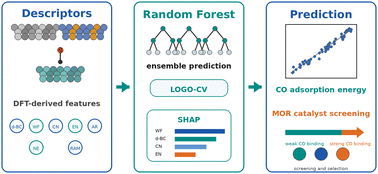
Understanding adsorption energetics is critical for the rational design of methanol oxidation reaction (MOR) catalysts. In this work, a machine-learning framework is developed to predict the CO adsorption energetics of mono- and bimetallic catalysts relevant to the MOR. The model integrates density functional theory (DFT)-derived data with physically meaningful electronic and geometric descriptors, including the work function, d-band center, coordination number, and electronegativity, achieving accurate and robust predictions. Feature correlation and distribution analyses confirm that the selected descriptors are statistically well-conditioned, while chemical-cluster-based validation identifies the optimized Random Forest model as a robust predictor within the chemical space represented by the present dataset. SHAP-based interpretability analysis reveals that adsorption energetics are governed by a cooperative interplay between surface electronic potential, orbital interactions, and local coordination environment, highlighting pronounced nonlinear structure–property relationships. All descriptors used in this study are readily accessible from simple theoretical calculations or literature databases, enabling rapid screening of candidate catalysts without extensive experimental characterization. This work provides a practical machine-learning-driven framework for the early-stage screening of MOR-relevant catalyst surfaces and for future descriptor development in more compositionally complex catalyst systems.
 Please wait while we load your content...


