


 PLATFORM UPDATE:


Designing a family of 2D kagome monolayers B18S8, B18S8H2, and B18S6X2 (X = Cl, Br, I) with tunable Dirac cones and high Fermi velocities

Abstract
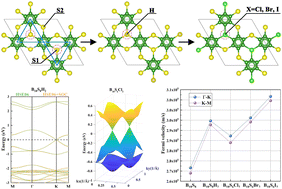
Two-dimensional (2D) kagome materials have become a hot research topic in the current scientific community due to their unique electronic structural properties, and the design of novel 2D kagome materials represents a significant exploration direction in this field. In this study, by employing the “1+3” design strategy, surface passivation and charge balance strategies, we successfully designed a novel family of 2D kagome materials B18S8, B18S8H2 and B18S6X2 (X = Cl, Br, I). Electronic structure analysis revealed that although B18S8 exhibits excellent kagome band characteristics, its Dirac cone is located approximately 1 eV above the Fermi level, making it difficult to utilize. However, by surface hydrogen passivation, the Dirac cone can be effectively adjusted to the Fermi level. Further research found that introducing halogen atoms to replace surface sulfur atoms can similarly adjust the position of the Dirac cone to the Fermi level. The Fermi velocities near the Dirac cone for these five materials reach as high as 2.69–3.07 × 10⁵ m s−1. Additionally, spin–orbit coupling can open a bandgap of approximately 20–55 meV at the Dirac cone. Our research not only provides an outstanding example for the design of 2D boron-based kagome materials but also fully demonstrates the immense potential of such materials in the electronics field.
 Please wait while we load your content...


