



Tailoring the many-body effects and phase configurations in monolayer MSi2X4 (M = Mo, W; X = N, P, As, Sb) for wide-range bandgap engineering
 *c
*c
Abstract
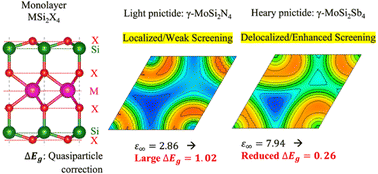
Monolayer MoSi2N4 has emerged as a landmark 2D semiconductor due to its exceptional stability and unique septuple-layer architecture. In this study, we employ first-principles calculations combined with GW quasiparticle corrections to systematically investigate the electronic evolution and phase stability of MSi2X4 (M = Mo, W; X = N, P, As, Sb). We demonstrate that substituting N with heavier pnictogens triggers a definitive ground-state transition to the γ phase. More importantly, we find that incorporating P, As, or Sb induces a transition to direct-bandgap character at the K point, a feature consistently observed across all examined configurations (α, β, and γ). Our quasiparticle results reveal an extraordinary bandgap tunability of ∼3.0 eV, spanning from the ultraviolet to the near-infrared spectrum. Crucially, we uncover a systematic collapse of many-body renormalization effects, where the quasiparticle correction (ΔEg) diminishes from over 1.0 eV in nitrides to ∼0.2 eV in antimonides. This phenomenon is quantitatively linked to the transition from localized, weakly-screened states to a highly polarizable dielectric environment with enhanced p–d hybridization. Our findings establish a versatile strategy for tailoring the electronic response of “thick” 2D systems, providing a roadmap for designing next-generation nanoelectronics across the ultraviolet to infrared spectrum.
 Please wait while we load your content...


