



Probing sulfur-centered intra- and intermolecular interactions in mercaptoethanol from the gas to liquid phase: a raman spectroscopic and theoretical study

Abstract
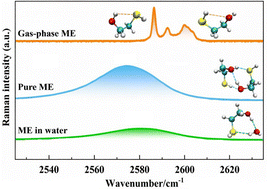
Sulfur-centered hydrogen bonding plays an important yet insufficiently understood role in molecular structure and intermolecular interactions due to the relatively low electronegativity of sulfur. Mercaptoethanol (HSCH2CH2OH, ME), containing both S–H and O–H functional groups, serves as an ideal prototype for examining sulfur-involved hydrogen bonds in different environments. In this work, high-resolution gas-phase Raman spectra of ME were recorded in the S–H stretching region using stimulated photoacoustic Raman spectroscopy and analyzed in conjunction with quantum chemical calculations and temperature-dependent measurements. Comparison between experimental and simulated spectra enables an unambiguous assignment of individual Raman bands to specific conformers and reveals that gauche conformers stabilized by O–H⋯S intramolecular hydrogen bonds dominate in the gas phase, while S–H⋯O intramolecular interactions are present but extremely weak. In contrast, liquid-phase Raman spectra exhibit a red shift of the S–H stretching band in neat mercaptoethanol relative to that in an aqueous solution. Quantum chemical calculations on ME–ME and ME–H2O dimers demonstrate that this red shift originates from a significantly enhanced S–H⋯O intermolecular hydrogen bond in the liquid state. These results provide direct spectroscopic evidence for the environment-dependent nature of sulfur-centered hydrogen bonding and offer molecular-level insights into the interplay between intramolecular and intermolecular interactions involving sulfur.
 Please wait while we load your content...


