


 PLATFORM UPDATE:


Energetically quasi-integrable roaming in the ionized CH4 + CO system: nonequilibrium dynamics of acetaldehyde formation

Abstract
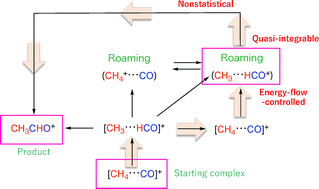
Roaming reactions—nonstatistical pathways that bypass conventional transition states—were first discovered in photochemistry and were later shown to influence decomposition mechanisms under high-energy conditions relevant to combustion and atmospheric chemistry. Recent work has further revealed that roaming is often enabled by transient, energetically quasi-integrable states emerging within nonequilibrium energy distributions, where fragment motions become dynamically decoupled and intramolecular energy redistribution is strongly suppressed. Building on this perspective, we investigate an ionization-triggered roaming process in the CH4 + CO system that leads to the formation of an acetaldehyde cation (CH3CHO+). Using high-level electronic structure calculations and ab initio direct molecular dynamics (AIMD) simulations, we show that ionization generates a strongly perturbed complex in which the internal energy is partitioned unevenly among its fragments. Rather than following the minimum-energy reaction coordinate, the system enters a dynamically decoupled intermediate, in which the motions of CH3 and HCO+ become dynamically isolated. This transient quasi-integrable state suppresses intramolecular energy redistribution, stabilizing a long-lived roaming configuration characterized by large-amplitude relative fragment motion. This dynamical regime enables C–C bond formation to yield an acetaldehyde cation without passing through conventional isomerization transition states. These results demonstrate that ionization can create roaming-accessible, energetically quasi-integrable regimes even in small molecular systems that are often assumed to follow statistical behavior. The findings further suggest that ionization-driven, roaming-mediated reactions may provide a possible pathway to complex organic ions in cold, low-density astrophysical environments. However, the present simulations do not include radiative cooling or collisional stabilization, and the astrophysical relevance of this mechanism therefore remains speculative.
 Please wait while we load your content...


