


Tuning graphene oxide selectivity under normal reaction conditions using dopants and nucleophiles towards cyclic or polycarbonate formation: A DFT study

Abstract
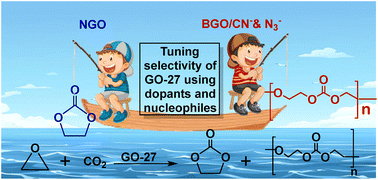
The catalytic conversion of epoxides and CO2 into cyclic carbonates and polycarbonates offers a promising route for sustainable carbonate synthesis; however, controlling product selectivity remains a key challenge. In this work, the DFT method was employed to evaluate the catalytic performance of graphene oxide (GO) and its doped analogues in the cycloaddition reaction of epoxides and CO2 under normal reaction conditions. The structurally representative model GO-27 possessing hydrogen bond donor (HBD) edges (–OH and –COOH) stabilised the substrate through H-bonding interactions. Although both edges participated in the reaction, the –COOH site was kinetically favoured. However, the unmodified GO-27 exhibited poor selectivity, with comparable activation barriers for cyclic carbonate (+14.2 kcal mol−1) and polycarbonate (+12.2 kcal mol−1) formation. To address the selectivity issue, GO-27 was doped with nitrogen (NGO) and boron (BGO) atoms. NGO destabilised the HOMO by 0.2 eV relative to GO-27, enhancing the electron-donating nature and stabilising the ring-closure transition states, thereby favouring the cyclic carbonate over the polycarbonate by +3.9 kcal mol−1. In contrast, the BGO stabilised the LUMO by 1.0 eV, enhancing the electron-accepting nature and promoting the chain-initiation step, which extensively favoured the polycarbonate over the cyclic carbonate by +5.7 kcal mol−1. Furthermore, the product selectivity can be controlled by the choice of nucleophiles. Among the tested nucleophiles (I−, Br−, Cl−, CN−, and N3−), the poorer leaving groups, CN− and N3−, hinder cyclic carbonate formation, shifting selectivity towards polycarbonates by +37.8 and +13.3 kcal mol−1, respectively. This work demonstrates that GO-based catalysts can be strategically engineered to achieve targeted selectivity in the cycloaddition of epoxides and CO2.
 Please wait while we load your content...


