


 PLATFORM UPDATE:


Regulating second harmonic generation of telluromolybdate materials by atomic substitution
 ab
ab
Abstract
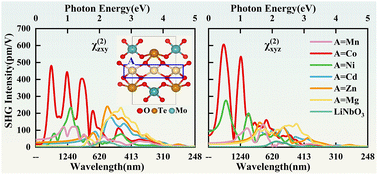
Second harmonic generation (SHG) is an important nonlinear optical process, which has promising applications in photonics and optoelectronic devices. However, the weak nonlinear response in traditional nonlinear optical crystals limits the applications of SHG. Tellurite molybdenum quaternary oxides (ATeMoO6, ATMOs) are an interesting class of nonlinear optical crystals. Substitution of A-site atoms is expected to efficiently modulate the properties. In this study, nine ATMOs (A = Mn, Fe, Co, Ni, Ru, Ag, Cd, Zn, and Mg) were constructed and their electronic properties and SHG responses were studied using first-principles calculations. Our results indicate that A-site cation substitution can significantly modulate the nonlinear optical properties. ATMOs (A = Ag, Fe, and Ru) exhibit ferromagnetic and semi-metallic behavior with 100% spin polarization, making them promising candidates for applications in spintronics. The other six ATMOs (A = Mn, Co, Ni, Cd, Zn, and Mg) are all semiconductors with a strong SHG response in either the visible region or the infrared region. Specifically, the SHG intensity of CoTeMoO6 in the mid-infrared region (606.64 pm V−1) and near-infrared region (534.70 pm V−1) is about 10 times higher than the SHG response value of LiNbO3. This work points out that tellurium molybdate materials have excellent nonlinear optical properties and potential applications in electronics and nonlinear optics.
 Please wait while we load your content...


