



Unraveling defect-mediated ion transport behavior in anti-perovskite solid-state electrolytes via machine learning molecular dynamics simulations
 a
Yong
Pei
*ab
a
Yong
Pei
*ab
Abstract
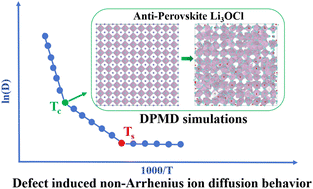
Anti-perovskite (AP) solid-state electrolytes (SSEs) have emerged as promising candidates for high-safety solid-state batteries due to their wide electrochemical window and good compatibility with lithium metal anodes. However, their relatively low ionic conductivity significantly hinders their commercial application. Although defect engineering is considered a key strategy to enhance ionic conductivity, the influence of different defect types on the microscopic mechanisms of ion diffusion remains unclear. Moreover, conventional simulation methods struggle to accurately capture the temperature-dependent ion diffusion behavior in complex defect systems. Herein, we employed machine learning molecular dynamics simulations to systematically investigate the effects of various vacancy, interstitial, and composite defects on Li ion transport in the AP Li3OCl SSE. Simulation results demonstrated that the type of defect significantly influences Li ion diffusion ability. The Li ion diffusion ability of the defective systems decreases in the following order: systems with Li vacancies > systems with Li interstitial defects > systems with only anion vacancies > perfect crystal structure. Notably, non-Arrhenius behavior was observed in some defective systems. Structural analysis revealed that the non-Arrhenius behavior originates from thermal disorder-induced local octahedral distortions and the correspondingly generated high-energy lithium-ion sites. This study provides a significant micro-level theoretical foundation for understanding the mechanisms governing ion transport in AP materials.
 Please wait while we load your content...


