


 PLATFORM UPDATE:

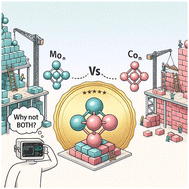
Stability trends of near- and equiatomic (n ⋍ m) ConMom and MonCom (n + m = 2–15) subnanoalloys from DFT and K-means clustering
 a
Amanda Souza
Alves,
a
Maíra
dos Santos Costa
a
and
Karla Furtado
Andriani
*a
a
Amanda Souza
Alves,
a
Maíra
dos Santos Costa
a
and
Karla Furtado
Andriani
*a
Abstract
Understanding the stability mechanisms of subnanoalloys is essential for the predictive design of functional nanomaterials. In this work, we present a systematic investigation of the structural, energetic, and electronic properties governing the stability of near-equiatomic and equiatomic ConMom and MonCom subnanoalloys with n ≈ m and n + m = 2–15, by integrating ab initio density functional theory (DFT) calculations with data-science analysis. The results demonstrate that, within this well-defined compositional regime, cluster stability is highly sensitive to the distribution of cobalt and molybdenum atoms relative to their unary parent clusters. Configurations in which cobalt contributes more directly to the structural framework exhibit enhanced stability, characterized by more negative binding and excess energies, stronger chemical mixing, and higher effective coordination numbers. These features are accompanied by more compact geometries, increased spin polarization, and enhanced heteronuclear Co bonding driven by favorable 3d–4d orbital hybridization. In contrast, molybdenum plays a complementary role by modulating the electronic structure and accommodating structural flexibility, without acting as the primary stabilizing component of the bimetallic core. Distinct stabilization regimes emerge due to quantum size effects, with near- and equiatomic compositions exhibiting an optimal energetic balance across the investigated size range. Overall, these findings provide fundamental insight into Co synergy at the subnanometer scale and establish a physically grounded basis for future studies of Co-based functional materials.
 Please wait while we load your content...


