


 PLATFORM UPDATE:


Efficient development of a neural network potential for pure silica zeolites
 *a
*a
Abstract
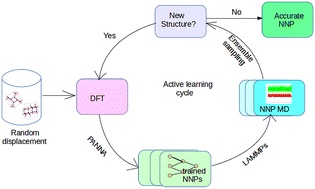
The use of machine learning interatomic potentials (MLIPs) has increased the size and timeframe of molecular dynamics simulations by offering accuracy comparable to density functional theory (DFT) at a fraction of the computational cost. However, developing MLIPs typically requires large training datasets, which carry substantial computational expense when generated with DFT. In this work we show that, for crystal structures with similar compositions but different topologies, such as pure silica zeolites, a hierarchical clustering strategy can be used to identify a small set of representative polymorphs and, thus, construct an efficient compact dataset via an active learning workflow. Furthermore, this active learning phase was carried out using a non-compute intensive invariant neural network potential. From the ab initio data generated during active learning, we then developed two MLIPs based on invariant and equivariant architectures, respectively. Both neural network potentials achieve energy errors of 3 meV per atom or less on the datasets when compared with ab initio results. In addition, structural, mechanical, thermal, and phonon dispersion properties of the zeolites predicted by the MLIPs exhibit excellent agreement with the corresponding ab initio calculations, demonstrating the high fidelity of the developed models.
 Please wait while we load your content...


