


 PLATFORM UPDATE:


Tuning the electronic and magnetic properties of Janus MoSSe monolayers via non-magnetic atom-substituted doping of Se atoms: a first-principles study
 *a
Yanhong
Gu
a
*a
Yanhong
Gu
a
Abstract
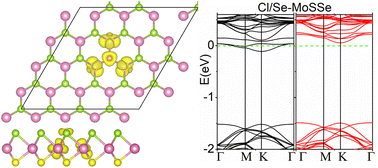
First-principles calculations are employed to systematically investigate the structural stability and the electronic and magnetic properties of Janus MoSSe monolayers via substitutional doping with non-magnetic atoms (B, Al, C, Si, N, P, F, and Cl) at the Se site. All doped configurations exhibit excellent structural and thermal stability, with negative formation energies comparable to that of the pristine monolayer. It is found that doping with B, Al, N, P, F, and Cl atoms effectively induces stable ferromagnetic ground states at room temperature, while C and Si doping results in paramagnetic semiconductors. Crucially, B-, Al-, and Cl-doped systems demonstrate half-metallic behavior, characterized by a metallic spin channel coexisting with a semiconducting one. The origin of magnetism and half-metallicity is traced to the local bonding environment of Mo atoms at the doping center, which is attributed to the incomplete passivation of Mo d-orbital electrons in B/Al/Cl-doped systems, while in N/P-doped systems the effect primarily arises from the dopant pz orbitals. Furthermore, this study explores dual Cl doping, revealing that the magnetic ground state is critically dependent on the Cl–Cl separation, governed by the competition between localized moment formation and antiferromagnetic coupling. This work establishes non-magnetic element doping as a potent and structurally benign strategy for tailoring magnetism and achieving half-metallicity in two-dimensional Janus materials, presenting a promising avenue for developing ultrathin spintronic and quantum devices.
 Please wait while we load your content...


