



Tunable ferrovalley semiconductors of Janus VSeCl and VSeBr
 *ab
*ab
Abstract
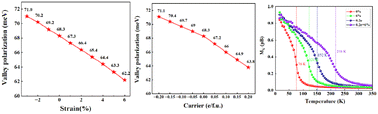
2D ferrovalley semiconductors have attracted extensive research interest due to their valley degree of freedom, which is useful for encoding, storing, and manipulating information. To achieve a large valley polarization and high Curie temperature in ferrovalley semiconductors based on the experimentally synthesized VSe2, we conduct first-principles calculations on Janus VSeCl and VSeBr monolayers and investigate their magnetic and valley properties induced by strain and carrier doping effects. It is found that both the monolayers are dynamically and thermally stable, indicating their experimental feasibility similar to the parent VSe2 material. Both VSeCl and VSeBr are ferrovalley semiconductors with valley polarizations of 68.3 and 65.1 meV and Curie temperatures of 76 and 106 K, respectively. Compressive strain and hole doping could increase the valley polarization (up to 71.1 meV for VSeCl) due to the enhanced spin–orbit coupling, while tensile strain and electron doping could increase the Curie temperature (up to 218 K) due to the enhanced ferromagnetic super-exchange interaction. Hole doping induces the transition of the magnetic easy axis from in-plane to out-of-plane, which is dominated by the (dxy/dx2−y2) orbitals of V atoms and (px/py) orbitals of Se atoms. These tunable magnetic and valley properties induced by strain and carrier doping make Janus VSeCl and VSeBr promising candidates for spintronic and valleytronic applications.
 Please wait while we load your content...


