


 PLATFORM UPDATE:


Exploring the sensing potential of Sc2CO2 and Sc2CO2/WSe2 heterostructures towards volatile organic compounds of standard food products by first-principles density functional theory calculations

Abstract
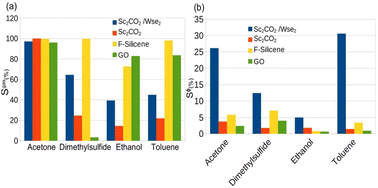
Volatile organic compounds (VOCs), namely acetone, dimethylsulfide, ethanol and toluene, indicate the stages of degradation of standard food products like fruits, meat and vegetables. Using density functional theory, this work investigates the potential of Sc2CO2 MXene and its heterostructure with a known transition metal di-chalcogenide WSe2 towards detecting and distinguishing these VOCs, acting as a chemiresistive, work function-based and optical sensor. Our results demonstrate the correlations between the adsorption geometry, strength of adsorption, charge re-distribution and charge transfer between these Mxene surfaces and the VOC molecules, and highlight the mechanisms behind the trends observed in them. We find that the presence of WSe2 in the heterostructure enhances the sensing capability of the MXene. We attribute this to the internal electric field acting along the interface made by the constituents and the availability of extra electronic states from WSe2. The results show that the heterostructure can act as an efficient dual-mode sensor, establishing the importance of MXene and MXene–TMDC as a class of potential nanosensors for quality assessment of generic food products.
 Please wait while we load your content...


