


DFT investigation of electronic modulation and site specific CFC-11 sensing on difuran functionalized heptazine based g-C3N4

Abstract
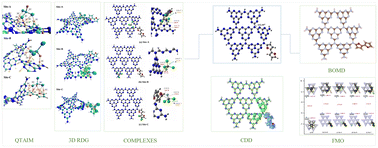
Although the Montreal Protocol has substantially reduced the use of CFCs, their unintended release and unregulated emission have persisted, necessitating advanced sensing technologies for accurate monitoring. In this study, we have investigated Hz-df as a potential sensor for CFC-11 using DFT and TD-DFT methodologies. Structural optimization has demonstrated that df functionalization significantly enhances the electronic properties of pristine Hz, as confirmed by CDD and TDM analyses, which have revealed improved charge delocalization and excitation characteristics. The adsorption of CFC-11 has been examined at three active sites (Site A, Site B, and Site C). BSSE-corrected interaction energies have indicated that Site A exhibits the strongest interaction, closely followed by Site B, while Site C shows comparatively weaker binding. NBO analysis has supported these findings, with Sites A and B showing greater charge transfer than Site C. NCIs have been validated through 2D/3D RDG isosurfaces and MEP mapping, and QTAIM analysis has confirmed bond critical points corresponding to stable intermolecular interactions. DOS analysis has revealed site-specific electronic perturbations, and UV-Vis spectral analysis has shown distinct shifts in λmax for all complexes, confirming the optical sensing capability of Hz-df. Kinetic desorption analysis has indicated a slower recovery at Site A, moderate and practical reversibility at Site B, and the fastest recovery at Site C. Temperature-dependent analysis has demonstrated that Hz-df dynamically adjusts its adsorption characteristics with changing thermal conditions, allowing additional sites to become active at higher temperatures or analyte concentrations, thereby exhibiting adaptive and thermally resilient sensing performance across varying environmental regimes. Humidity effects, evaluated through competitive and co-adsorption models, have demonstrated site-dependent behavior, with cooperative stabilization at Site B under moist conditions and partial suppression at other sites. Furthermore, BOMD simulations (45.5 fs, NVE ensemble) have confirmed the dynamical stability and structural robustness of Hz-df at finite temperature. Collectively, these results have established Hz-df as a stable, selective, and environmentally viable platform for real-time atmospheric monitoring of CFC-11.
 Please wait while we load your content...


