


 PLATFORM UPDATE:

N-Terminal mutations in SARS-CoV-2 NSP1 alter the structure and dynamics of its C-terminal disordered region, impacting mRNA translation in ribosomes: insights from molecular dynamics simulations
 *c
and
Hung
Van Nguyen
*d
*c
and
Hung
Van Nguyen
*d
Abstract
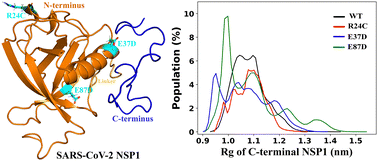
Although numerous studies have demonstrated that mutations in the N-terminal domain of SARS-CoV-2 non-structural protein 1 (NSP1) alter the C-terminal domain and affect host mRNA translation, the full mechanistic understanding of how these mutations change NSP1 behaviour remains incomplete. In this research, we employ molecular dynamics (MD) simulations to investigate the conformational effects of single-point mutations (R24C, E37D, and E87D) in the N-terminal domain of NSP1. Our analysis reveals that these mutations can induce long-range allosteric effects on the C-terminal domain, which is critical for NSP1's role in suppressing host translation. Clearly, the E37D mutant stabilizes a native-like conformation with enhanced helical propensity, suggesting a pre-ordered conformation potentially primed for ribosome binding. The R24C mutation weakens long-range dynamic coupling, increasing conformational heterogeneity and destabilizing the native C-terminal β-sheet. The E87D mutant induces the most severe perturbation, resulting in an extension yet an internally labile and disordered C-terminal ensemble characterized by high flexibility, loss of persistent hydrogen bonds, and a fragmented free energy landscape. These findings elucidate how allosteric networks within NSP1 communicate perturbations from the N-terminal domain to fine tune the functional dynamics of the C-terminus, providing a key framework for understanding how sequence variations modulate viral functions.
 Please wait while we load your content...


