



Kinetics and general reaction rules for hydrogen atom abstraction reactions from C4–C7 oxygenated fuels by hydroxyl radicals
 a
a
Abstract
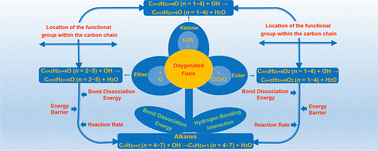
Understanding the combustion kinetics of oxygenated fuels is critical for optimizing efficiency and reducing emissions. This study investigates how carbon chain lengths and functional groups affect the hydrogen atom (H) abstraction kinetics between HȮ radicals and C4–C7 oxygenated hydrocarbons (esters, ethers, ketones, and aldehydes) using ab initio quantum chemistry and reaction kinetics methods. It is found that key kinetic parameters, such as energy barriers (EBs) and rate constants, strongly depend on the functional group type, the position of the H-abstraction site along the carbon chain, and the spatial distance between the site and the functional group. Comparative analysis with relevant 1-alkane fuels reveals notable differences in reaction pathways proximal to functional groups, while distal pathways retain similar characteristics. Furthermore, it is indicated that oxygen-containing functional groups influence reaction characteristics primarily by altering bond dissociation energies (BDEs) and participating in the formation and breaking of hydrogen bonds. Crucially, a generalized predictive rule for H-abstraction from oxygenated fuels is established, integrating chain-length effects, site-specific BDE variations, and hydrogen bond dynamics. This rule enables accurate extrapolation of rate constants for long-chain fuels, addressing gaps in existing models reliant solely on BDE approximations.
 Please wait while we load your content...


