


 PLATFORM UPDATE:


Allosteric activation of FGFR2 kinase in endometrial cancer: insights from Gaussian accelerated molecular dynamics and the Markov state model
 a
and
Parimal
Kar
*a
a
and
Parimal
Kar
*a
Abstract
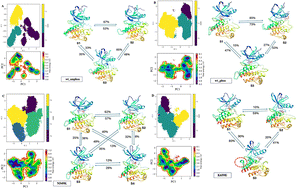
Endometrial carcinoma (EC) is one of the most prevalent gynaecological malignancies found in women. About 10%–12% of EC cases are caused by mutations in fibroblast growth factor receptor 2 (FGFR2). FGFR2 is a tyrosine kinase receptor involved in multiple biological processes such as cell proliferation, migration and homeostasis. N549K and K659E mutations of the FGFR2 kinase domain increase the basal kinase activity by 7- to 32-fold. Here, we have considered these mutations along with the wild-type phosphorylated and unphosphorylated FGFR2 kinase to investigate the overall structural dynamics supporting kinase activation in the mutant systems. The Gaussian accelerated molecular dynamics (GaMD) approach was utilised to minimise the potential energy barrier during the simulation. These results suggest that the mutant systems are more stable than the wild-type ones. The Markov state model (MSM) analysis and principal component analysis (PCA) highlighted the higher percentage of active-like kinase conformations obtained from the mutant systems, which could be a reason behind their higher basal kinase activity. The disengaged molecular brake was believed to be the driving force for mutant kinase activation. The MSM and protein structure network (PSN) analysis feature the allosteric communication caused by mutations. The MSM shows the formation of a secondary structure in the αDE loop of the K659E mutant system. The PSN and electrostatic interaction reveal that the activating mutations regulate long-range interactions among the αDE loop and αD, αE and αF helices. The pockets made by these regions can act as allosteric sites for inhibitor design. Overall, this study may aid in better therapeutic intervention against endometrial cancer.
 Please wait while we load your content...


