


Analytically optimized noise redistribution in pulsed dipolar EPR spectroscopy
 a
S. A.
Agarkin
b
and
a
S. A.
Agarkin
b
and
Abstract
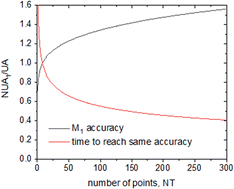
Non-uniform data acquisition protocols are derived analytically for optimizing the measurement of nanometer distance using pulsed dipolar spectroscopy methods, such as DEER (double electron–electron resonance). The random measurement noise is redistributed by non-uniform averaging of the signal. This optimizes the accuracy and efficiency of the measurement of the first four non-central moments of the distribution of distances within pairs of spin labels attached to nanostructures. With these protocols, the mean distance can typically be measured with the same accuracy in half the time or with 40% greater accuracy in the same time. Different signal averaging schemes are optimal for each of the first four moments, but the optimal scheme for the first moment works well for all moments and for the measurement of the entire distance distribution of distances in the sample. These protocols were tested in silico using three approaches for analysis of the DEER data: the Tikhonov regularization, model-based fitting, and Mellin transform approaches. The non-uniform acquisition protocols produced significantly better results than each of the analysis protocols.
 Please wait while we load your content...


