


 PLATFORM UPDATE:


4f-Electron localization in Ce-embedded Co6Te8 clusters for enhanced CO2 reduction catalysis

Abstract
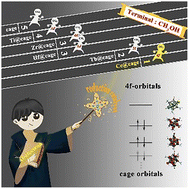
Density functional theory (DFT) calculations were employed to investigate the CO2 reduction reaction (CO2RR) on a series of metal-embedded Co6Te8(PH3)5 chalcogenide clusters, incorporating transition metals and f-block elements including Ti (3d), Zr (4d), Hf (5d), Ce (4f/5d), and Th (5f/6d). Structural modifications introduced by metal embedding were found to effectively tune the electronic structure, thereby altering the reactivity of the host cluster. Subsequently the interplay between f and d orbitals was systematically analyzed to reveal its role in modulating catalytic activity. Among all candidates, Ce@Co6Te8(PH3)5 exhibits the lowest endothermic energy along the CO2RR pathway, suggesting its superior catalytic performance. This behavior arises from the unique participation of Ce 4f states, which enhance both π* antibonding population and Pauli repulsion at the Co–CO interface. These two effects jointly weaken the net interaction, making CO desorption most favorable on Ce@cage and thereby accelerating the catalytic cycle. Additionally, 4f electron localization narrows the HOMO–LUMO energy gap, further increasing the electronic reactivity of the cluster. These findings highlight 4f electron localization as a key descriptor for designing high-performance molecular catalysts based on chalcogenide clusters.
 Please wait while we load your content...


