


 PLATFORM UPDATE:


DFT investigation of AunMo (n = 2–12) clusters: the barrierless hydrogen adsorption behavior of Au9Mo

Abstract
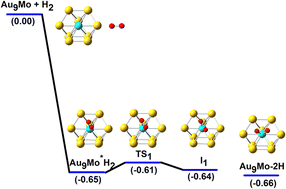
Bimetallic gold–molybdenum clusters have attracted considerable attention for their potential in hydrogen-related applications, including catalysis and energy storage. In this study, we employ density functional theory to systematically investigate the interaction of H2 with small AunMo clusters (n = 2–12). Our findings reveal that the cluster geometries remain stable upon both molecular and dissociative adsorption of H2. The preferred adsorption configuration arises from a balance of factors including the adsorption site (surface vs. encapsulated Mo), electronegativity difference, and atomic coordination. Dissociative adsorption is identified to be both thermodynamically and kinetically favorable for n = 6, 8, and 9 species. With a submerged barrier of 0.04 eV for activating the hydrogen dissociation process, Au9Mo exhibits potential as a hydrogen storage and catalytic material. In contrast, significant energy barriers hinder dissociative H2 adsorption on Au5Mo and Au7Mo, while clusters with n = 2–4 and 10–12 exhibit a thermodynamic preference for molecular adsorption.
 Please wait while we load your content...


