


 PLATFORM UPDATE:


Development of a novel direct Z-scheme Sb2WO6/Ag3PO4 nanocomposite with sustainable design for simultaneous electrochemical detection of Pb2+ and photocatalytic degradation of RhB dye

Abstract
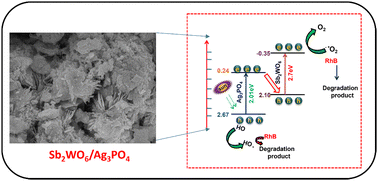
In this study, a facile and highly sensitive electrochemical strategy was developed for the detection of Lead (Pb2+) ions in aqueous media using cyclic voltammetry (CV) and differential pulse voltammetry (DPV). A glassy carbon electrode (GCE) modified with silver phosphate nanoparticles anchored on hierarchical antimony tungstate (Sb2WO6/Ag3PO4) served as the sensing platform. The modified electrode exhibited a distinct oxidation peak for Pb2+ at −0.4 V in DPV analysis, confirming its strong electrocatalytic response. Electrochemical impedance spectroscopy and CV studies further validated the enhanced charge transfer efficiency of the nanocomposite-modified GCE. Optimization of deposition potential and accumulation time yielded a low detection limit of 90.0 nM, demonstrating remarkable sensitivity. Beyond sensing, the Sb2WO6/Ag3PO4 nanocomposite was employed for photocatalytic degradation of Rhodamine B (RhB) dye, achieving an 85% degradation rate for RhB and the elevated reaction rate constant value of 0.01167 ± 3.6132 min−1 for Sb2WO6/Ag3PO4, synthesised via a hydrothermal route and characterized by XRD, FTIR, UV-Vis, SEM, and EDX analyses. Photocatalytic studies revealed superior degradation efficiency under alkaline conditions, with kinetics following a pseudo-first-order model consistent with a direct Z-scheme charge transfer mechanism. These findings demonstrate the versatility of Sb2WO6/Ag3PO4 for simultaneous electrochemical sensing and environmental remediation applications.
 Please wait while we load your content...


