


Comparative structural analysis of PtCo and PtNi bimetallic clusters: a systematic study using the MCDE algorithm
 *b
*b
Abstract
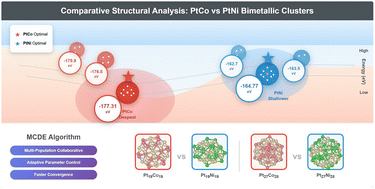
Comparative structural optimization of PtCo and PtNi bimetallic clusters presents significant challenges due to complex potential energy landscapes and competing structural motifs. In this work, we develop a Multi-Cooperative Differential Evolution (MCDE) algorithm with enhanced convergence mechanisms and apply it to the systematic structural prediction of PtmCon and PtmNin clusters (N = 38 or 55). The algorithm employs multi-strategy cooperative optimization and adaptive parameter control to improve global search efficiency for bimetallic systems. Comparative analysis with the basin hopping genetic algorithm (BHGA) and traditional self-adaptive differential evolution with neighborhood search (SaNSDE) demonstrates that MCDE achieves 50–75% faster convergence and significantly higher success rates. Selected low-energy structures are further validated through density functional theory (DFT) calculations, confirming the reliability of the Gupta potential predictions and revealing enhanced electronic properties in optimized configurations. Excess energy and second-order difference energy calculations examine thermodynamic stability and compositional preferences, while bond orientational parameters and Common Neighborhood Analysis quantitatively characterize structural features. Systematic comparison demonstrates that PtCo systems exhibit more favorable mixing thermodynamics with sharp compositional selectivity, whereas PtNi systems show superior absolute stability with predictable structural evolution. Optimal PtCo clusters display complex structural regionalization with mixed coordination environments, while PtNi clusters maintain predominantly uniform icosahedral arrangements. Our work demonstrates the effectiveness of the improved algorithm and provides fundamental insights into the structure–stability relationships of bimetallic nanoclusters.
 Please wait while we load your content...


