



Structure and vibrational spectra of formamidinium bromide

Abstract
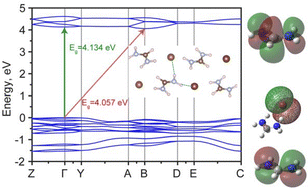
The crystal structure, electron states and vibrational spectra of formamidinium bromide (FABr) crystals are studied with the use of quantum-mechanical density functional computational methods. The obtained results show good agreement when compared with available experimental data both in terms of structure and vibrational spectra. The spatial and electronic structure of FA cations in the crystal and molecular state are compared to identify the influence of the crystalline environment. It is shown that cation–anion binding is purely ionic. The bottom state of the conduction band corresponds to the LUMO state of the FA cation. The upper state of the valence band corresponds to the 4p lone-pair of the Br anion. Particular attention is paid to N–H⋯Br hydrogen bonds, for which the characteristic spectroscopic features are determined. Due to the low symmetry of the FABr crystal, the structure contains four nonequivalent N–H⋯Br hydrogen bonds. Analysis of the calculated and experimental results showed that the Raman and IR spectra in the 600–800 cm−1 region contain four clearly distinguishable peaks, each of which corresponds to the out-of-plane vibration of the FA cation localized on a separate hydrogen bond. This finding makes it possible to propose a spectroscopic method for monitoring the presence of various hydrogen bonds in the crystal under study and related compounds.
 Please wait while we load your content...


