


 PLATFORM UPDATE:


Effect of bridge type on electronic structure and rectification in molecular junctions
 *ab
*ab
Abstract
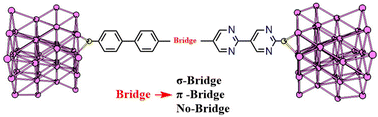
This study links the chemistry of isolated molecules with the physics of two-probe systems by exploring the role of molecular bridges in rectification through density functional theory (DFT) and nonequilibrium Green's function (DFT–NEGF) methods. Two classes of molecules are studied: Group A (A–bridge–D), which is based on a pyrimidinyl–phenyl dithiol scaffold where the pyrimidinyl ring acts as an electron acceptor (A) and the phenyl ring as a donor (D), with thiol anchoring groups; and Group B (2A–bridge–2D), which uses dipyrimidinyl–diphenyl dithiol scaffolds designed to examine the impact of extended conjugation. For both groups, three types of bridges are investigated: σ-bridge, π-bridge, and direct linkage. The computational workflow includes (i) DFT calculations to evaluate how external electric fields influence the structural and electronic properties of isolated molecules, and (ii) DFT–NEGF simulations of two-probe systems, where molecules are placed between gold electrodes. Electron transport properties—such as current–voltage (I–V) characteristics, density of states (DOS), and transmission spectra—are analyzed systematically. The results indicate that σ-bridge molecules exhibit the strongest rectification, with the 2A–σ–2D molecule reaching the highest rectification ratio of 6.7 at 2 V. These findings demonstrate a clear link between the chemistry of isolated molecules and the physics of molecular junctions, further supported by a linear regression correlation.
 Please wait while we load your content...


