


 PLATFORM UPDATE:


Enhanced SHG efficiencies in V-shaped ferrocene-appended pyrimidinium salt using a salt methodology with theoretical insights

Abstract
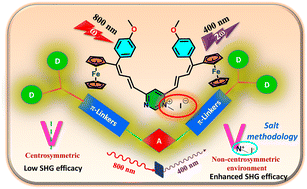
An enhanced second-harmonic generation (SHG) effect was observed in the V-shaped ferrocene-appended methylated pyrimidinium salt (2) rather than in the corresponding pyrimidine chromophore (1). Although the pyrimidine chromophore (1) was crystallized in a centrosymmetric monoclinic (P2/c) system, it still exhibited pseudo SHG efficiencies due to the synergistic effect involving the out-of-plane deviation of the pendant auxiliary methoxy phenyl donor and the ferrocene moiety and noncovalent interactions (C–H⋯π), which results in reduced antiparallel alignment in the solid state. Electrochemical studies showed one-electron transfer from ferrocene to the ferrocenium ion (Fe2+ ⇌ Fe3+), and we also observed a reduction peak at 0.42 V for the oxidation of iodide to iodine in chromophore 2. Solvatochromic studies revealed that chromophore 1 showed positive solvatochromism (99 nm) due to a high excited-state dipole moment. In contrast, it was only 19 nm for chromophore 2, indicating a higher ground-state dipole moment than the excited state because of the methyl pyrimidinium ion. As expected, the ferrocene-appended pyrimidinium salt (2) showed a 2.8-fold enhanced SHG efficiency compared to (1), arising from the formation of a non-centrosymmetric environment in the bulk, which is achieved by adopting the “salt methodology” technique, by conversion of pyrimidine to pyrimidinium ion, creating parallel alignment by steric effect and dipolar repulsions. This further increases the electron-withdrawing nature, consequently enhancing the NLO effect. Moreover, density functional theory (DFT) and time-dependent density functional theory (TD-DFT) calculations were performed at the B3LYP/6-31+G** level, and the theoretical results aligned well with the experimental results.
 Please wait while we load your content...


