


 PLATFORM UPDATE:


Effect of confinement on PH3 and OH3+ inversion

Abstract
Encapsulating molecules in nanocages such as C60 provides a unique opportunity to probe how spatial confinement alters structure and dynamics. We examine umbrella inversion in hydronium (OH3+) and phosphine (PH3) in the gas phase and inside C60. Inversion profile computations for OH3+ and PH3 are based on high-level correlated methods [CCSD(T)/aug-cc-pVTZ and aug-cc-pVQZ]. Modelling confined systems requires dealing with the cage and the encapsulated molecules together, which is computationally complex. Therefore, results pertaining to encapsulated systems are based on dispersion-corrected DFT (B97-D/aug-cc-pVTZ). Barrier heights and tunnelling splittings for OH3+ and PH3 are benchmarked against CCSD(T)/aug-cc-pVQZ results. For free OH3+, the CCSD(T) barrier is computed to be ∼706 cm−1, while B97-D yields a slightly lower value (612 cm−1). The predicted tunnelling doublets closely match the experimental findings. Encapsulation of hydronium in C60 (denoted as OH3+@C60, where X@C60 indicates the encapsulation of X within C60) raises the barrier height from 612 to 871 cm−1 and markedly suppresses the splittings. In contrast, PH3 exhibits an extremely high inversion barrier (∼11 000 cm−1), effectively quenching tunnelling. Upon confinement, the barrier is lowered marginally, and the vibrational eigenstate energies are shifted upward. The interaction energies obtained using the DLPNO-CCSD(T)/def2-TZVP method confirm the stability of the encapsulated systems: −30.8 kcal mol−1 for OH3+@C60 and −13.4 kcal mol−1 for PH3@C60. Energy decomposition analysis shows that OH3+@C60 stabilization is predominantly electrostatic in nature, whereas the dispersion term in PH3@C60 is considerably larger.
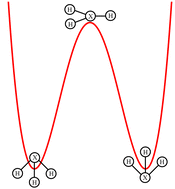
- This article is part of the themed collection: Structure and dynamics of chemical systems: Honouring N. Sathyamurthy’s 75th birthday
 Please wait while we load your content...


