


 PLATFORM UPDATE:

Interaction of gaseous nitric acid and water on thiol-based molecular overlayers on C70

Abstract
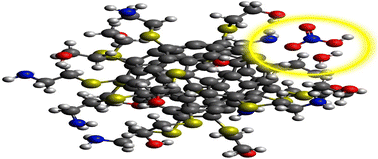
We present a theoretical investigation of the stability and interactions of nitric acid and water on molecular overlayers formed by alkanethiols adsorbed on C70. Density functional theory calculations reveal that nitric acid is efficiently trapped by thiol-functionalized C70, with adsorption energies ranging from −62 to −90 kJ mol−1. The binding strength is governed by the polarity of the thiol terminations, with mixed –OH/–NH2 overlayers exhibiting the strongest adsorption (−90 kJ mol−1) due to cooperative hydrogen bonding. In all cases, the random mixture of thiols on the C70 surface is more stable than segregated domains by 100–150 kJ mol−1, a phenomenon driven by the anisotropic curvature of the fullerene which enhances dipole–dipole coupling and suppresses phase separation. Nitrate formation via full dissociation into NO3− and H3O+ is thermodynamically unfavourable; however, a feasible pathway involving partial proton transfer to the thiol sulfur atom is identified, with activation barriers of 70–100 kJ mol−1 that are lowered by 10–20 kJ mol−1 in the presence of water. Born–Oppenheimer molecular dynamics simulations at 300 K reveal that confinement within the C70 cage enables transient hydronium formation, whereas the acid remains molecular in the inter-chain regions of the thiol layer. Infrared spectral analysis demonstrates the evolution of HNO3 vibrational modes upon hydration, showing broadening and red-shifts of 20–40 cm−1 consistent with strong hydrogen bonding. The results establish functionalized C70 as a model for probing confined proton dynamics and provide quantitative insight into acid adsorption on curved carbon interfaces.
 Please wait while we load your content...


