


 PLATFORM UPDATE:


Voronoi-based analysis linking microscopic void evolution to macroscopic swelling in supercritical CO2-saturated polymers

Abstract
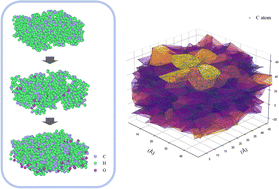
This study investigates the expansion behavior of EPDM rubber in supercritical carbon dioxide (scCO2) through molecular dynamics (MD) simulation, and employs Voronoi analysis to correlate the evolution of microscopic pores with macroscopic swelling. It systematically explores the effects of CO2 density, temperature, and polymer density, revealing that Voronoi-based free volume characterization provides key insights into the underlying mechanisms. The main findings from the Voronoi analysis are that at high CO2 densities, Voronoi void plots show a significant increase in larger void volumes and obvious spatial heterogeneity, which helps explain the apparent contradiction between localized CO2 accumulation and inhibited macroscopic expansion; elevated temperatures promote the formation of larger and more uniformly distributed pores within the polymer matrix, thereby increasing CO2 penetration depth and ultimately leading to structural degradation; and lower polymer densities are more likely to form interconnected channels that facilitate rapid CO2 diffusion, while higher polymer densities result in more isolated and evenly spaced voids that restrict CO2 diffusion. This paper elucidates the density-dependent expansion dynamics using the Voronoi method, explains the pressure-induced critical expansion phase transition, and establishes a link between microscopic free volume topology and macroscopic deformation. Overall, this work demonstrates that Voronoi analysis serves as a robust tool for studying multiscale polymer-fluid interactions under scCO2 conditions.
 Please wait while we load your content...


