


Theoretical investigation of high-pressure phase stability and potential superconductivity of Ce–S–H ternary hydrides
 ab
ab
Abstract
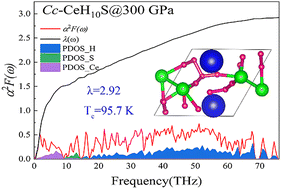
The discovery of high-temperature superconductivity in lanthanide- and sulfur-hydrides has attracted substantial interest recently. Here, we systematically investigate the high-pressure phase stability and superconducting properties of Ce–S–H ternary hydrides using first-principles calculations coupled with swarm-intelligence-based structure prediction methods. Our calculations reveal that all considered compositions (CeSH2, CeSH3, CeSH6, CeSH8, CeSH9 and CeSH10) exhibit thermodynamic and dynamic stability within the pressure range of 50–300 GPa. The hydrogen configurations in these compounds feature diverse motifs, including isolated H atoms, molecular “H2” and “H3” units, and H–S covalent networks, as validated by electron localization function (ELF) and Bader charge analysis. Notably, electron–phonon coupling (EPC) calculations identify Cm-CeSH9 and Cc-CeSH10 as promising superconductors, with transition temperatures (Tc) of 73.3 K at 150 GPa and 95.7 K at 300 GPa, respectively. These findings highlight the potential of Ce–S–H systems as high-Tc candidates under high-pressure conditions.
 Please wait while we load your content...


