


A comparative analysis of isomerization pathways in 3- and 4-styrylpyridines

Abstract
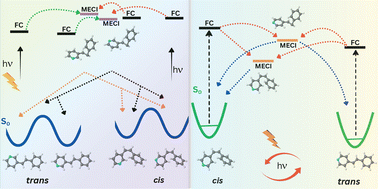
In this work, we report on possible isomerization and cyclization pathways in 3-styrylpyridine (3-STPY) and 4-styrylpyridine (4-STPY) isomers. A thorough comparative analysis based on the computational results obtained using the second-order Møller–Plesset (MP2) and algebraic diagrammatic construction to the second-order (ADC(2)) methodologies is presented. The positional variation of the nitrogen atom in the pyridine ring relative to the styryl group alters electronic distribution in the system and influences molecular conformational diversity. While there are two distinct rotamers for each of the trans, cis, and cyclized conformers in 3-STPY, symmetry in 4-STPY limits conformational flexibility, yielding only a single isomer per configuration. To elucidate the non-radiative decay channels operative upon photoexcitation, minimum energy conical intersection structures (MECIs) between the ground and first excited states were calculated using the complete active space self-consistent field (CASSCF) method. We analyzed cis and trans isomerization as well as cyclization mechanisms along image-dependent pair potential (IDPP) pathways. Our results reveal that isomerization through twisted-pyramidalized MECIs originating from the cis side involves lower energy barriers than from the trans side, with 3-C2 → 3-CI1 and 4-C1 → 4-CI1 identified as the most favorable pathways for 3-STPY and 4-STPY, respectively. Additionally, relaxation toward the cyclized MECIs proceeds with little to no energy barriers in both systems. The findings offer mechanistic insight into the excited-state processes in styrylpyridine derivatives and suggest isomer-specific pathways for photoinduced isomerization and cyclization of the two molecules.
- This article is part of the themed collection: Structure and dynamics of chemical systems: Honouring N. Sathyamurthy’s 75th birthday
 Please wait while we load your content...


