


 PLATFORM UPDATE:


Comment on “Noble gas decorated planar tetracoordinate oxygen” by K. Sarmah, F. Yashmin, A. Das, L.-X. Bai, J.-C. Guo and A. K. Guha, Phys. Chem. Chem. Phys., 2025, 27, 10923

Abstract
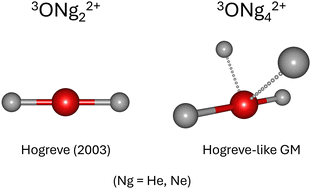
In a recent study, Sarmah et al. (Phys. Chem. Chem. Phys., 2025, 27, 10923, https://doi.org/10.1039/D5CP01278C) reported a planar tetracoordinate oxygen structure as the global minima of the ONg42+ (Ng = He, Ne) species. However, their analysis was restricted to the singlet state. Here, we reexamined the potential energy surfaces of these systems considering both singlet and triplet states. Our results reveal that the true global minima correspond to triplet states with C2v symmetry, which lie significantly lower in energy than the previously reported D4h singlet structures. Furthermore, Born–Oppenheimer molecular dynamics simulations at 298 and 350 K show that both OHe42+ and ONe42+ dissociate spontaneously, suggesting that these species are metastable at ambient temperature and may only persist under cryogenic conditions. These findings highlight the importance of accounting for multiple spin states when searching for global minima in systems with unconventional bonding motifs.
 Please wait while we load your content...


