


Single transition metal atoms anchored on WSe2/WS2 heterostructures as efficient bifunctional electrocatalysts for the OER/ORR
 *ac
and
Jing
Li
*a
*ac
and
Jing
Li
*a
Abstract
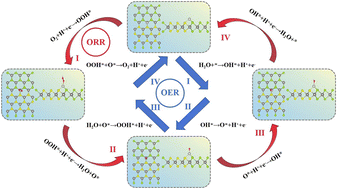
Searching for efficient and stable bifunctional electrocatalysts for the oxygen evolution reaction (OER) and oxygen reduction reaction (ORR) is crucial for realizing large-scale applications of electrolytic water splitting processes for clean energy production. Herein, using density functional theory (DFT) calculations, we systematically investigate the catalytic activity of 22 different transition metal (TM) atoms anchored on WSe2/WS2 heterostructures, which are screened as possible catalysts for both OER and ORR processes. Energetic analysis and ab initio molecular dynamics simulations showed that the proposed materials are stable under ambient conditions. The Pd@WSe2/WS2 structure is predicted to be an outstanding candidate for a bifunctional OER/ORR electrocatalyst, with an OER overpotential of 0.41 V and an ORR overpotential of 0.49 V, which are comparable to those of traditional monofunctional catalysts. Perhaps even more promisingly, we obtained a structure that does not require expensive noble metals (Ni@WSe2/WS2) that exhibit low overpotentials for both the OER and ORR (0.48 V/0.78 V) and could be an interesting alternative to bifunctional catalysts. The mechanisms behind the reactions involved in the catalysis are explained in detail using several calculated electronic properties. Our results not only endow TM@WSe2/WS2 bifunctional electrocatalysts with excellent catalytic activities, but also provide important insights for advancing clean energy technologies.
 Please wait while we load your content...


