


 PLATFORM UPDATE:


Effects of trimethylamine N-oxide and urea on the structure of water at liquid–vapor interfaces studied through theoretical vibrational sum frequency generation spectroscopy

Abstract
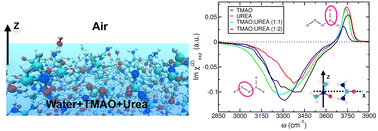
The behavior of small osmolytes such as urea and trimethylamine N-oxide (TMAO) in their aqueous mixtures provides key information on their role in modulating protein stability. To investigate the role of TMAO and urea in affecting water structure at liquid–vapor interfaces, we have calculated the vibrational sum-frequency generation (VSFG) spectra of liquid–vapor interfaces of binary and ternary aqueous mixtures of these osmolytes using the electronic structure/molecular dynamics (ES/MD) approach. We found that both osmolytes are present at the interface, but they are not preferentially surface active. VSFG spectra reveal that the OH modes of water are more strongly hydrogen bonded to TMAO than urea. The intensity of the dangling OH groups decreases in the VSFG spectra of ternary mixtures compared to the binary mixtures due to the formation of hydrogen bonds between free OH groups and osmolytes. At the interface, the orientations of TMAO and urea reveal that direct hydrogen bonding between these osmolytes is not favorable. Our results show that TMAO and urea alter the interfacial water structure through hydrogen bonding and their orientation. In the ternary mixtures, TMAO modifies the local water structure at the interface, which in turn affects interactions of urea with interfacial water.
 Please wait while we load your content...


