


 PLATFORM UPDATE:


Toward a deeper understanding of H–Ni3C interactions: rule-based insights

Abstract
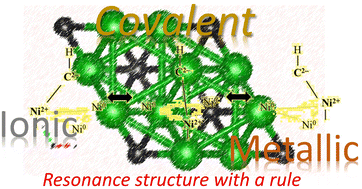
Ni3C exhibits high catalytic activity for hydrogen evolution and hydrogenation reactions; however, the electronic structure of the Ni3C surface has not been sufficiently investigated to clarify its interaction mechanism with H. In this study, we theoretically elucidate the fundamental rules governing the interaction between H atoms and Ni3C surfaces: (1) the formal charge and valence of C are −2 and 2, respectively, (2) bonding Ni to C has a formal charge of +2, and (3) the formal valence of Ni2+ is 2. Resonance structures based on these rules enable an a priori discussion of the geometries, electronic structures, and interactions of Ni3C surfaces with H atoms. Specifically, reconstruction of the Ni3C(113) surface, correlation between Ni–H bonding strength and the number of Ni–C interactions, and heterolytic dissociation of hydrogen have been derived, which are important for understanding Ni3C catalysis. These insights cannot be obtained from the d-band centre theory, nor can they be completely predicted using state-of-the-art machine learning interatomic potentials. This study clearly demonstrates the importance of understanding the degree of metal–carbon covalency for accurately interpreting the catalytic activity of nickel carbides.
 Please wait while we load your content...


