


 PLATFORM UPDATE:


Experimental demonstration of enhanced displacement by phase separation in a two-dimensional milli-model in viscously unstable fluid displacement

Abstract
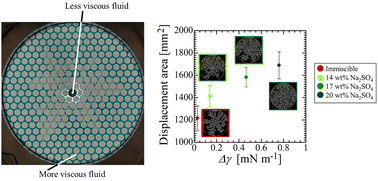
Interfacial phase separation in flowing systems has emerged as a key phenomenon in soft matter and interfacial science, particularly because of its coupling with interfacial hydrodynamics. Although viscous fingering (VF) has been widely explored in fully miscible and immiscible systems in porous media or Hele-Shaw cells, the pore-scale dynamics of partially miscible systems undergoing phase separation inside porous structures remain virtually unknown, despite their direct relevance to multiphase transport and enhanced displacement in geological and industrial processes. Herein, we present the first experimental demonstration of partially miscible VF in a porous-media-like two-dimensional milli-model, which explicitly incorporates pore and throat geometries. By systematically comparing fully miscible, immiscible, and partially miscible systems, we reveal that partially miscible displacement generates pore-scale droplet formation, self-propelled droplets, pore-geometry-dependent droplet bypassing and splitting, the interaction between self-propelled droplets and pore throats, and channel redirection and spreading induced by droplet-generated resistance. Quantitative analysis using several indicators—interfacial tension difference, droplet number, area density, and angular fluctuation amplitude—shows that the displacement efficiency increases monotonically with the magnitude of phase separation. We consider that this increase is due to the cooperative action of Korteweg-force-driven convection and droplet-induced Jamin blocking. Our finding of enhanced spreading is unique to partially miscible flows in porous structures and demonstrates how thermodynamic instability can be harnessed to control and improve displacement processes.
 Please wait while we load your content...


