


 PLATFORM UPDATE:


A novel defect-selective etching method for β-Ga2O3 single crystals based on hydrofluoric acid
 *ab
and
Deren
Yang
ab
*ab
and
Deren
Yang
ab
Abstract
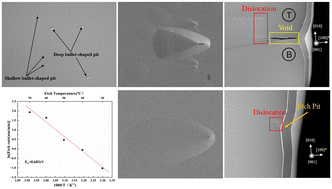
Wet chemical etching is widely applied in wide-bandgap semiconductors such as β-Ga2O3 due to its high efficiency, simplicity, and low cost. It can reveal surface defects via differential etching rates (defect regions manifest as etch pits), with the choice of etchant being critical. Conventional etchants, such as phosphoric acid, alkali solutions and molten alkalis, all require operation at elevated temperatures (≥100 °C), which entails additional process complexity and equipment requirements, making them less preferable. In this work, we investigated the defect-selective etching of β-Ga2O3 (100) surfaces using a mixed HF–HNO3 solution at lower temperatures. Dislocations and voids were effectively revealed after immersing at 60 °C in an HF–HNO3 solution for 2 h, and the resulting etch pits exhibited regular morphologies and could be directly distinguished through optical microscopy. This investigation not only expands the scope of etchant selection but achieves defect-selective etching at a reduced temperature of 60 °C, highlighting its commercial potential for the surface treatment of β-Ga2O3.
 Please wait while we load your content...


