


 PLATFORM UPDATE:


pH-Regulated structural evolution enables excitation-dependent tunable and quasi-white-light emission in tetrazole-based d10 coordination polymers
 *b
*b
Abstract
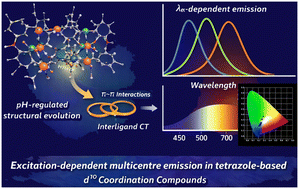
Single-component materials capable of excitation-dependent colour tuning and white-light-like emission are attractive for solid-state lighting and display technologies, yet remain challenging because multiple emissive states must be balanced within a single crystalline phase. Herein, a pH-regulated hydrothermal strategy affords three d10 coordination polymers assembled from 5-(1H-tetrazol-5-yl)isophthalic acid (H3TZI) and auxiliary N-donor ligands. Structural analyses reveal that pH, together with the metal center and auxiliary ligand, influences ligand deprotonation, metal–ligand connectivity, and supramolecular packing, thereby leading to distinct 1D, 2D, and discrete structural motifs. All compounds exhibit excitation-wavelength-dependent photoluminescence, enabling tunable emission across the visible region and quasi-white-light-like emission. Density-of-states calculations indicate ligand-dominated electronic structures, with emission originating from intrinsic ligand luminescence and π–π-interaction-assisted interligand charge-transfer transitions. These results highlight how deprotonation state, coordination environment, and packing mode can be jointly tuned to regulate emission behavior in tetrazole-based luminescent coordination materials.
 Please wait while we load your content...


