Sustainable manufacturing of CALF-20 via a ZnO-based route eliminating the washing step

Yuhi Kawachi a, Yuto Higuchi bc and Shunsuke Tanaka *bcd
aGraduate School of Science and Engineering, Kansai University, 3-3-35 Yamate-cho, Suita-shi, Osaka 564-8680, Japan
bDepartment of Chemical, Energy and Environmental Engineering, Faculty of Environmental and Urban Engineering, Kansai University, 3-3-35 Yamate-cho, Suita-shi, Osaka 564-8680, Japan. E-mail: shun_tnk@kansai-u.ac.jp; Web: https://wps.itc.kansai-u.ac.jp/sepsyseng/
cOrganization for Research and Development of Innovative Science and Technology (ORDIST), Kansai University, 3-3-35 Yamate-cho, Suita-shi, Osaka 564-8680, Japan
dCarbon Neutrality Research Center (CNRC), Kansai University, 3-3-35 Yamate-cho, Suita-shi, Osaka 564-8680, Japan

Received 20th December 2025 , Accepted 30th January 2026

First published on 30th January 2026


Abstract

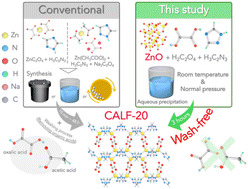
In this study, we present a sustainable and scalable synthesis route for CALF-20 by employing zinc oxide (ZnO) as the zinc source, thereby eliminating the washing step that is required in previously reported methods. CALF-20 synthesized using ZnO exhibits CO2 adsorption performance comparable to the literature while achieving complete crystallization within 3 h and reaching a high zinc-based yield of 97.1%. This environmentally benign process significantly reduces liquid waste generation and simplifies post-synthetic purification, offering strong potential for cost-effective, industrial-scale MOF production.

Introduction

Metal–organic frameworks (MOFs) are crystalline porous materials assembled from metal ions or clusters and organic ligands through coordination bonds.1–3 Their high surface areas, tuneable pore environments, and structural diversity have enabled applications in gas separation and storage,1,3–7 catalysis,8,9 and drug delivery systems.10,11 Among these applications, CO2 capture has emerged as a critical research area, and many MOFs exhibit high CO2 adsorption selectivity due to their tailored pore environments.12–16

CALF-20 is a zinc-based MOF composed of Zn2+ ions, 1,2,4-triazolate (Tzu), and oxalate (Ox2−), forming the framework Zn2(Tzu)2Ox, Zn2(H2C2N3)2(C2O4).17 Owing to favourable dispersion interactions between CO2 and the pore structure, CALF-20 exhibits high CO2 uptake and CO2/N2 selectivity.17–21 Additionally, its robust performance under humid conditions offers advantages over classical adsorbents such as zeolite-13X and Mg-MOF-76.17,22

Efforts to simplify CALF-20 synthesis have led to several solution-based, microwave-assisted, and mechanochemical methods.18,23–25 However, these routes rely on zinc oxalate or zinc acetate as precursors, producing organic acids as stoichiometric byproducts. Consequently, extensive washing steps are necessary to remove residual oxalate or acetate ions. These purification requirements, along with frequent use of organic solvents such as N,N-dimethylformamide (DMF), complicate waste management and hinder the scalable and sustainable production of MOFs.26–29 Developing synthetic routes that minimize waste liquid generation is therefore crucial for advancing green and economically viable MOF manufacturing.

Here, we report the first synthesis of CALF-20 using zinc oxide (ZnO) as the zinc source. This approach produces only water as a byproduct (eqn (1)) and eliminates the need for a washing step. We show that CALF-20 prepared using ZnO exhibits CO2 adsorption performance (3.94 mmol g−1) and BET surface area (545 m2 g−1) comparable to previously reported materials. We also examine how the omission of washing affects crystallinity, identify intermediates during the reaction, and elucidate the crystal transformation mechanism.

 
2ZnO + 2H3C2N3 + H2C2O4 → Zn2(H2C2N3)2(C2O4) + 2H2O(1)

Experimental section

Materials

All commercially available chemicals were used without further purification. Zinc oxide (≥98%), oxalic acid (≥99.5%), and methanol (≥99.5%) were purchased from Fujifilm Wako Pure Chemical Corporation. 1,2,4-Triazole (>99.0%) was purchased from Tokyo Chemical Industry Co.

Wash-free synthesis of CALF-20 using ZnO

First, 4.07 mmol of ZnO was added to an aqueous methanol solution (total volume: 20 mL; H2O/methanol = 16/4 mL) and stirred for 30 min using a magnetic stirrer. Separately, 4.07 mmol of 1,2,4-triazole and 2.04 mmol of oxalic acid were dissolved in another identical solvent mixture and stirred for 30 min. The two solutions were then combined and stirred for x hours (x = 1, 2, 3, 4, 5, 6, 24). The resulting solid was collected by centrifugation without any washing step. The product was dried in air at 100 °C and 101.3 kPa, followed by drying at 130 °C overnight under vacuum. The product is denoted as wf-CALF-20. In order to investigate the effect of the washing, a separate batch of the product was collected by centrifugation and washed six times with 40 mL of distilled water each time, followed by drying under the same conditions. Table S1 summarizes the detailed synthesis conditions of previously reported methods and this study.

Characterization

Powder X-ray diffraction (PXRD) patterns were collected using a MiniFlex 600 diffractometer (Rigaku) with CuKα radiation (λ = 1.5418 Å) operated at 40 kV and 15 mA. Particle morphologies were examined by field-emission scanning electron microscopy (FE-SEM, Hitachi S-4800). CO2 adsorption isotherms at 298 K and N2 adsorption–desorption isotherms at 77 K were measured using a BELSORP-mini x instrument (MicrotracBEL). Prior to measurements, samples were degassed at 498 K under vacuum for 4 h. Equilibrium was considered reached when the pressure change in the sample cell was within 0.3% for 180 s. The Brunauer–Emmett–Teller (BET) surface area and micropore volume were determined from N2 adsorption–desorption isotherms at 77 K. Micropore volumes were calculated using the t-plot method. Particle size distributions were measured at 298 K using a zeta-potential and particle size analyzer (ELS-ZDX, Otsuka Electronics). Thermogravimetric (TG) analysis was performed on a DTG-60H instrument (Shimadzu). Approximately 5 mg of sample was placed in an alumina cell and heated in air from room temperature to 800 °C at a rate of 2 °C min−1.

Results and discussion

The necessity of washing CALF-20 samples synthesized from ZnO was evaluated through a series of experiments. In these experiments, the samples were either washed six times or left unwashed. PXRD patterns (Fig. 1a) and SEM images (Fig. 1b) demonstrate that CALF-20 is formed in both cases with nearly identical crystallinity and morphology, thereby confirming that washing can be completely omitted.
image file: d5ce01201e-f1.tif
Fig. 1 (a) PXRD patterns of CALF-20 prepared from ZnO with and without the washing, showing the effect of washing on the crystalline phase. (b) FE-SEM images comparing the morphology of CALF-20 prepared with and without washing. Scale bar: 5 μm. For the washed sample, the product was collected by centrifugation and washed six times with distilled water before drying.

As shown in Fig. 2a, the PXRD patterns of the products vary with respect to the reaction time. At reaction times of 1–2 h, crystalline peaks attributable to CALF-20 were observed, along with peaks from zinc oxalate (2θ = 23.0–23.5°), one of the intermediates, and the starting material zinc oxide (2θ = 31.7–36.3°). However, following a duration of reaction exceeding 3 h, the crystalline peaks attributable to the intermediates and the starting material (Fig. S1) diminished, and instead, crystalline peaks originating from CALF-20 were observed. As shown in Fig. 2b, FE-SEM observations support two key findings: first, the crystallization proceeds through a sharp transition to the CALF-20 phase, and second, particle uniformity improves.


image file: d5ce01201e-f2.tif
Fig. 2 (a) PXRD patterns of wf-CALF-20, showing the effect of the reaction time on the crystallization of products prepared from ZnO. (b) FE-SEM images of wf-CALF-20 prepared with reaction times of 1–6 h. Scale bar: 2 μm.

During this crystallization process, complexes involving starting materials and intermediates were identified (Fig. S2), suggesting competitive coordination between ligands. This behaviour is attributed to the difference in acid dissociation constants between oxalic acid (Ox) and 1,2,4-triazole (Tz) in the synthesis solution. The pH of the solution was determined through the preparation of a CALF-20 synthesis mixture, employing water as the exclusive solvent and subjecting it to a reaction period of 3 h. The pH at the onset of mixing was 4.54, which increased to 5.81 after stirring, as measured with a pH meter. Although it has been well known that the apparent acidity of water/methanol mixtures is slightly lower than that of pure water,30 the actual CALF-20 synthesis solution still exhibited acidic conditions (approximately pH 5–6) when measured with pH paper, indicating that acidity is retained even in mixed solvents. The acid dissociation constant of Ox is smaller than that of Tz, meaning that deprotonation of Ox is favored under acidic conditions (eqn (2)–(4)). This suggests that the reaction of Ox with ZnO is predominant over that of Tz. Additionally, the DLS measurement results indicated that the mean particle size remained around 200 nm regardless of the stirring time.

Oxalic acid: pKa1 = 1.25

 
H2C2O4 + H2O ⇌ HC2O4 + H3O+(2)

Oxalic acid: pKa2 = 4.14

 
HC2O4 + H2O ⇌ C2O42− + H3O+(3)

1,2,4-Triazole: pKa = 10.1

 
H3C2N3 + H2O ⇌ H2C2N3 + H3O+(4)

TG curves of the products are presented in Fig. 3a. Eqn (5) describes the calculation of the mass percentage of ZnO contained in CALF-20, which is derived from the molecular weight of its chemical formula, Zn2(H2C2N3)2(C2O4). The theoretical residual mass of 45.9% corresponds to the fraction of 2ZnO expected after complete combustion of the organic components. For products synthesized with a reaction time of 3 h or longer, the TG curves exhibited behaviour consistent with previously reported data, and the residual mass closely approached this theoretical value of 45.9%. Conversely, the residual mass percentages for the samples prepared for 1 and 2 h were approximately 62%, indicating the presence of unreacted ZnO in the products. The weight-loss profiles of these samples closely resembled those of zinc oxalate, an intermediate species (Fig. S3). This finding suggests that the measured samples consist of unreacted starting material and intermediate species, which is consistent with the morphology observed in Fig. 2b. Furthermore, the conversion rate of ZnO to CALF-20 at each reaction time was determined by estimating the amount of CALF-20 present in each sample based on the residual mass corresponding to ligand decomposition (Fig. 3b). The experimental results unequivocally demonstrate that reaction times of 3 h and beyond result in nearly complete conversion of ZnO to CALF-20, thereby indicating the formation of high-purity CALF-20.

 
image file: d5ce01201e-t1.tif(5)


image file: d5ce01201e-f3.tif
Fig. 3 (a) TG curves of wf-CALF-20 prepared from ZnO with different reaction times. For comparison, TG data of CALF-20 prepared according to the reported procedure in ref. 23 are also shown. (2 °C min−1) (b) conversion of ZnO to CALF-20 at each reaction time, calculated based on the residual ZnO content.

The slightly lower thermal stability observed for the ZnO-derived CALF-20, in comparison to samples prepared via the conventional solvothermal method,20 is predominantly ascribed to its diminished particle size. The increased surface-to-volume ratio in these smaller particles has been demonstrated to augment surface-related effects, which can result in a reduction in the onset temperature of thermal decomposition. Notably, the high CO2 adsorption capacity suggests that the ZnO-derived CALF-20 possesses long-range order, indicating a low density of crystal defects. Therefore, the slight decrease in thermal stability is not attributable to structural defects, but rather is likely associated with the smaller particle size and surface-related effects. Nevertheless, the thermal stability remains sufficient for practical CO2 capture applications.

The CO2 adsorption performance, pore characteristics, and CALF-20 yield as a function of reaction time are presented in Fig. 4. In accordance with the trends evident in Fig. 1 and 2, there was a marked increase in performance at a reaction time of 3 h. The maximum CO2 adsorption capacity and BET surface area were achieved at a reaction time of 5 h, reaching 3.94 mmol g−1and 545 m2 g−1, respectively. In addition, the maximum yield of 97.1% was obtained at a stirring time of 6 h. These results indicate that the product synthesized via the ZnO route exhibits CO2 adsorption performance and pore characteristics comparable to those of samples washed with deionized water (Fig. S4 and S5), clearly demonstrating that a washing step is unnecessary when CALF-20 is produced through crystal conversion from ZnO.


image file: d5ce01201e-f4.tif
Fig. 4 Relationship between CO2 uptake at 298 K and 1.0 bar, BET surface area, and CALF-20 yield for wf-CALF-20 as a function of reaction time.

As shown in Fig. 4, both the CO2 uptake and BET surface area increase with reaction time and reach a maximum at 5 h, indicating that the formation of the CALF-20 framework is essentially complete within this time frame. The coordination-driven assembly of the Zn–Tz–Ox network proceeds relatively rapidly under the present synthesis conditions, leading to the development of accessible microporosity and adsorption sites within 5 h. Beyond this point, extending the reaction time to 24 h does not result in the creation of additional accessible porosity and new CO2 adsorption sites. Instead, prolonged reaction times may promote particle growth or aggregation, which can reduce gas accessibility and limit further improvements in adsorption performance without altering the intrinsic framework structure. This behavior is consistent with the formation of a thermodynamically stable CALF-20 framework possessing a self-limited number of adsorption sites. Consequently, a reaction time of 5 h represents an optimal condition that ensures complete framework formation while maintaining efficient synthesis and high CO2 adsorption performance.

To further investigate the results described above, Fig. S6 presents the PXRD patterns of products synthesized under static conditions, without stirring. For samples prepared from 1 h to 24 h, the PXRD patterns exhibited not only the characteristic peaks of CALF-20 but also peaks corresponding to unreacted zinc oxide and the intermediate zinc oxalate. Subsequent analysis via FE-SEM observations (Fig. S7) further corroborated the presence of particles derived from zinc oxide and zinc oxalate. These results suggest that, under static conditions, the intermediate zinc oxalate persists irrespective of reaction time. Fig. S8 shows the CO2 adsorption capacity, BET surface area, and CALF-20 yield for products obtained under static conditions. While CO2 adsorption capacity, BET surface area, and CALF-20 yield gradually increased from 1 h to 24 h, all values remained significantly lower than those for products synthesized with stirring. Fig. S9 shows photographs of the reaction mixture at different reaction times. The solution remained turbid up to 6 h, whereas by 24 h the solvent and solute had completely separated, indicating that the reaction had effectively ceased. These findings suggest that in the synthesis of CALF-20, the process of crystallization is significantly enhanced when the zinc source and ligands are homogenized by an external force, such as stirring, during the synthesis process.

The CALF-20 syntheses reported in previous literature were reproduced without the washing step. The crystallinity and CO2 adsorption performance of the resulting products were then compared (Fig. 5). The PXRD patterns shown in Fig. 5a substantiated the occurrence of peaks originating from CALF-20 in all samples, indicating that crystallization transpired from each synthetic method, even in the absence of washing. However, Fig. 5b revealed that omitting the washing step had a significant impact on CO2 adsorption performance. For methods using zinc oxalate dihydrate as the precursor (e.g., solvothermal17 and liquid-assisted grinding24), the CO2 adsorption capacity was largely maintained but was found to be slightly lower than reported values. This suggests that the methanol washing step listed in Table 1 assists in removing residual oxalic acid. In contrast, methods utilizing zinc acetate dihydrate as the precursor (e.g., room temperature23 and neat grinding25) exhibited CO2 adsorption capacities considerably lower than the previously reported (reductions of 30–65%). This decline is likely due to the occlusion of CO2 adsorption sites by residual acetate ions, which are expected to be removed during washing process but remained in the CALF-20 framework when washing is omitted. It should be noted that, for the reproduction of the neat grinding method reported in literature,25 a planetary ball mill was used in this study, whereas a vibrating mixer mill was employed in the original work. Despite applying a relatively high-energy milling condition for the available planetary mill, the reproduced sample exhibited a markedly lower CO2 uptake (1.23 mmol g−1) than the value reported in literature25 (3.39 mmol g−1). This discrepancy is likely due to fundamental differences in energy transfer, impact mode, and shear forces between vibrating mixer mills and planetary ball mills, highlighting the strong dependence of mechanochemical CALF-20 synthesis on the type of milling apparatus.


image file: d5ce01201e-f5.tif
Fig. 5 Comparison between unwashed CALF-20 samples prepared by previously reported methods and the wf-CALF-20 obtained by the method developed in this study. (a) PXRD patterns; (b) CO2 adsorption–desorption isotherms. (Open symbol: adsorption, closed: desorption).
Table 1 Comparison of CALF-20 synthesis in previous reports and in this study, including synthesis temperature, reaction time, yield, BET surface area, CO2 uptake, and washing procedures/solvents
Synthesis method Synthesis temp., time Zinc-based yield (%) S BET (m2 g−1) CO2 uptake (mmol g−1) Washing solvent Ref.
Solvothermal 453 K, 48 h 70 528 4.07@1.2 bar, 293 K Methanol 17
453 K, 48 h 70 2.86@0.2 bar/303 K Methanol 19
Microwave-assisted solvothermal 453 K, 48 h 97.3 548 4.02@1.0 bar, 298 K Methanol 18
Room temperature 298 K, 1 h 93.3 520 3.84@1.0 bar, 298 K Distilled water 23
Mechanochemical (liquid-assisted grinding) 298 K, 0.5 h 535 2.55@0.2 bar, 301 K DI water 24
Mechanochemical (neat grinding) 298 K, 0.25 h 97.0 551 3.39@1.0 bar, 298 K DI water 25
Wash-free 298 K, 3 h 97.1 545 3.94@1.0 bar, 298 K (2.71@0.2 bar, 298 K) Wash-free This work


These results confirm the necessity of the washing process using deionized water to remove acetate. For syntheses employing zinc organic acids, including a washing step is therefore essential to eliminate residual organic acids and methanol, thereby enhancing the purity of CALF-20. In contrast, CALF-20 synthesized from ZnO in this study maintained its CO2 adsorption performance without any washing. A comparison of synthesis methods—including synthesis time, yield, BET surface area, CO2 adsorption capacity, and the presence or absence of washing—presented in Table 1 shows that the properties of the ZnO-derived CALF-20 are comparable to those of previously reported samples. These findings further demonstrate that CALF-20 can be synthesized from the inexpensive zinc source ZnO and suggest that the washing step can be omitted in future scale-up processes, resulting in substantial cost savings in waste liquid treatment.

Conclusions

In this study, CALF-20 was successfully synthesized for the first time by replacing the zinc source from a zinc salt of an organic acid with the more economical zinc oxide. This modification eliminated the need for a washing step. This synthesis enables production in a mere three hours while maintaining a high yield of up to 97.1%, based on zinc content. Furthermore, the resulting material demonstrated CO2 adsorption performance and pore structure properties that were comparable to those of previously reported CALF-20. This process suggests that increasing CALF-20 production could significantly reduce the discharge of waste liquid associated with the washing step. To achieve large-scale production of CALF-20 as a viable CO2 capture material, further experimentation is necessary.

Author contributions

Y. K.: investigation, validation, data curation, formal analysis, writing – original draft; Y. H.: investigation, data curation, formal analysis; S. T.: conceptualization, methodology, formal analysis, data curation, funding acquisition, project administration, supervision, writing – original draft, writing – review & editing.

Conflicts of interest

There are no conflicts to declare.

Data availability

All data supporting the findings of this study are provided in the supplementary information (SI) associated with this article.

Supplementary information: additional experimental details, characterization data, and supplementary table and figures supporting the results discussed in the main text. See DOI: https://doi.org/10.1039/d5ce01201e.

Acknowledgements

The authors gratefully acknowledge financial support from JSPS KAKENHI Grant Numbers JP24K21706, the Kansai University Fund for Supporting Outlay Research Centers, 2024, JKA and its Promotion Funds from KEIRIN RACE, Grant No. 2023M-412, and the FY2023 Research Grant Program of the Carbon Recycling Fund Institute, Japan.

Notes and references

  1. Editorial, A market for metal–organic frameworks, Nat. Mater., 2025, 24, 157 Search PubMed.
  2. Z. Chen, K. O. Kirlikovali, P. Li and O. K. Farha, Acc. Chem. Res., 2022, 55, 579–591 CrossRef CAS PubMed.
  3. M. A. Abdelkareem, Q. Abbas, E. T. Sayed, N. Shehata, J. B. M. Parambath, A. H. Alami and A. G. Olabi, Energy, 2024, 299, 131127 Search PubMed.
  4. H. Li, K. C. Wang, Y. J. Sun, C. T. Lollar, J. L. Li and H. C. Zhou, Mater. Today, 2018, 21, 108–121 CrossRef CAS.
  5. D. Alezi, Y. BelMabkout, M. Suyetin, P. M. Bhatt, Ł. J. Weselinśki, V. Solovyeva, K. Adil, I. Spanopoulos, P. N. Trikalitis, A. H. Emwas and M. Eddaoudi, J. Am. Chem. Soc., 2015, 137, 13308–13318 Search PubMed.
  6. W. J. Su, Y. Y. Xiang, Y. Y. Dai, Y. Y. Wang, S. Y. Zhong and J. Li, Chem. Commun., 2014, 60, 7124–7135 RSC.
  7. Y. M. Zhang, B. H. Yin, L. Z. Huang, L. Ding, S. Lei, S. G. Telfer, J. Caro and H. H. Wang, Prog. Mater. Sci., 2025, 151, 101432 CrossRef CAS.
  8. A. Purvika, S. Yadav, S. P. Jijoe, T. Tenzin, V. Divya, B. Shahmoradi, K. Wantala, D. Jenkins, G. Mackey and H. P. Shivaraju, Mater. Today Sustain., 2024, 26, 100745 Search PubMed.
  9. L. Jiao, Y. X. Zhou and H. L. Jiang, Chem. Sci., 2016, 7, 1690–1695 RSC.
  10. S. Y. He, L. Wu, X. Li, H. Y. Sun, T. Xiong, J. Liu, C. X. Huang, H. P. Xu, H. M. Sun, W. D. Chen, R. Gref and J. W. Zhang, Acta Pharm. Sin. B, 2021, 11, 2362–2395 CrossRef CAS PubMed.
  11. K. K. Sun, L. Li, X. L. Yu, L. Liu, Q. T. Meng, F. Wang and R. Zhang, J. Colloid Interface Sci., 2017, 486, 128–135 CrossRef CAS PubMed.
  12. S. M. Jeong, K. H. Cho, S. K. Lee, J. W. Yoon, J. S. Lee, D. Jo and U. H. Lee, ACS Sustainable Chem. Eng., 2024, 12, 8165–8173 CrossRef CAS.
  13. R. D'Amato, A. Donnadio, M. Carta, C. Sangregorio, D. Tiana, R. Vivani, M. Taddei and F. Costantino, ACS Sustainable Chem. Eng., 2019, 7, 394–402 CrossRef.
  14. B. Than-ardna, S. Hiranphinyophat, M. Matsumoto, V. Meeyoo and B. Kitiyanan, Resour. Chem. Mater., 2025, 4, 100116 CAS.
  15. R. C. Lei, W. Shen, Z. L. Yang, H. X. Jin, W. X. Chai, X. L. Guo, H. L. Ge and D. F. Jin, Mater. Today Sustain., 2025, 31, 101181 Search PubMed.
  16. M. Pardakhti, T. Jafari, Z. Tobin, B. Dutta, E. Moharreri, N. S. Shemshaki, S. Suib and R. Srivastaba, ACS Appl. Mater. Interfaces, 2019, 11, 34533–34559 CrossRef CAS PubMed.
  17. J. B. Lin, T. T. T. Nguyen, R. Vaidhyanathan, J. Burner, J. M. Taylor, H. Durekova, F. Akhtar, R. K. Mah, O. Ghaffari-Nik, S. Marx, N. Fylstra, S. S. Iremonger, K. W. Dawson, P. Sarkar, P. Hovington, A. Rajendran, T. K. Woo and G. K. H. Shimizu, Science, 2021, 374, 1464–1469 CrossRef CAS.
  18. D. Pereira, M. Sardo, R. Vieira, I. Marín-Montesinos and L. Mafra, Inorg. Chem., 2025, 64, 3302–3310 CrossRef CAS PubMed.
  19. T. T. T. Nguyen, J. B. Lin, G. K. H. Shimizu and A. Rajendran, Chem. Eng. J., 2022, 442, 136263 Search PubMed.
  20. T. Al-Attas, S. K. Nabil, A. S. Zeraati, H. S. Shiran, T. Alkayyali, M. Zargartalebi, T. Tran, N. N. Marei, M. A. A. Bari, H. Lin, S. Roy, P. M. Ajayan, D. Sinton, G. K. H. Shimizu and M. G. Kibria, ACS Energy Lett., 2023, 8, 107–115 CrossRef CAS.
  21. A. Rajendran, G. K. H. Shimizu and T. K. Woo, Adv. Mater., 2024, 36, 2301730 CrossRef CAS PubMed.
  22. J. Drwęska, K. Roztocki and A. M. Janiak, Chem. Commun., 2025, 61, 1032–1047 Search PubMed.
  23. Y. Higuchi, M. Sugita, S. Moriya, T. Takewaki and S. Tanaka, Microporous Mesoporous Mater., 2024, 274, 113137 CrossRef.
  24. F. Raganati, M. Bellusci, F. Leardi, F. Varsano and P. Ammendola, Chem. Eng. J., 2025, 506, 159966 CrossRef CAS.
  25. N. Phongsuk, C. Chaemchamrat, T. K. Saothayanun, N. Weeranoppanant and S. Bureekaew, CrystEngComm, 2025, 27, 5959–5964 Search PubMed.
  26. D. Chakraborty, A. Yurdusen, G. MouChaham, F. Nouar and C. Serre, Adv. Funct. Mater., 2024, 34, 2309089 CrossRef CAS.
  27. C. Mottillo and T. Friščić, Molecules, 2017, 22, 144 CrossRef PubMed.
  28. V. F. Yusuf, N. I. Malek and S. K. Kailasa, ACS Omega, 2022, 7, 44507–44531 Search PubMed.
  29. S. Fujita, K. Kadota, A. Koike, H. Uchiyama, Y. Tozuka and S. Tanaka, RSC Mechanochem., 2024, 1, 153–157 Search PubMed.
  30. M. Woodhead, M. Paabo, R. A. Robinson and R. G. Bates, J. Res. Natl. Bur. Stand., A Phys. Chem., 1965, 69, 263–270 Search PubMed.

This journal is © The Royal Society of Chemistry 2026
Click here to see how this site uses Cookies. View our privacy policy here.