


 PLATFORM UPDATE:


Examining the role of molecular and crystallographic symmetry in isomorphism: a series of centrosymmetric “bridge-flipped” trifluoromethyl-substituted bis-benzylideneanilines

Abstract
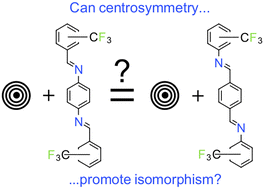
“Bridge-flipped isomers” are pairs of organic molecules differing only in the reversal of a bridge of atoms connecting two major parts of the molecules. Among the benzylideneanilines, the isomerism is R–CH![[double bond, length as m-dash]](https://www.rsc.org/images/entities/char_e001.gif) N–R′ vs. R–NCH–R′ (R, R′ = aryl). Isomorphous pairs of bridge-flipped benzylideneanilines are rare. This study is focused on pairs of molecularly centrosymmetric bis-benzylideneanilines to determine whether the tendency of centrosymmetric molecules to be located on crystallographic inversion centers, in combination with their overall similarity in molecular space-filling requirements, may promote their isomorphism. A survey of the Cambridge Structural Database for centrosymmetric bridge-flipped bis-benzylideneaniline pairs of the R–CHN–C6H4–NCH–R vs. R–NCH–C6H4–CHN–R type identified 23 pairs, only two of which are isomorphous. A survey for bridge-flipped diimine pairs of the R–CHN–NCH–R vs. R–NCH–CHN–R type identified six pairs, none of which are isomorphous. Conformational differences attributed to steric interaction between the bridge C–H hydrogen atom and a ring hydrogen atom account for most of the non-isomorphous cases. From examination of whether similar intermolecular packing motifs involving organic fluorine might promote isomorphism between molecularly centrosymmetric pairs, described here are the crystal structures of three pairs of bridge-flipped bis-benzylideneanilines prepared by reaction of 2-(trifluoromethyl)benzaldehyde, 3-(trifluoromethyl)benzaldehyde, and 4-(trifluoromethyl)benzaldehyde with p-phenylenediamine and by reaction of 2-(trifluoromethyl)aniline, 3-(trifluoromethyl)aniline, and 4-(trifluoromethyl)aniline with terephthalaldehyde. The 3-(trifluoromethyl) isomers, located on inversion centers and nearly planar, are isomorphous. Certain bis-benzylideneanilines assume crystal structures isomorphous with those of the corresponding bis-stilbene or bis-azo compound, although whether they do so more readily than with their bridge-flipped isomer has not been determined.
N–R′ vs. R–NCH–R′ (R, R′ = aryl). Isomorphous pairs of bridge-flipped benzylideneanilines are rare. This study is focused on pairs of molecularly centrosymmetric bis-benzylideneanilines to determine whether the tendency of centrosymmetric molecules to be located on crystallographic inversion centers, in combination with their overall similarity in molecular space-filling requirements, may promote their isomorphism. A survey of the Cambridge Structural Database for centrosymmetric bridge-flipped bis-benzylideneaniline pairs of the R–CHN–C6H4–NCH–R vs. R–NCH–C6H4–CHN–R type identified 23 pairs, only two of which are isomorphous. A survey for bridge-flipped diimine pairs of the R–CHN–NCH–R vs. R–NCH–CHN–R type identified six pairs, none of which are isomorphous. Conformational differences attributed to steric interaction between the bridge C–H hydrogen atom and a ring hydrogen atom account for most of the non-isomorphous cases. From examination of whether similar intermolecular packing motifs involving organic fluorine might promote isomorphism between molecularly centrosymmetric pairs, described here are the crystal structures of three pairs of bridge-flipped bis-benzylideneanilines prepared by reaction of 2-(trifluoromethyl)benzaldehyde, 3-(trifluoromethyl)benzaldehyde, and 4-(trifluoromethyl)benzaldehyde with p-phenylenediamine and by reaction of 2-(trifluoromethyl)aniline, 3-(trifluoromethyl)aniline, and 4-(trifluoromethyl)aniline with terephthalaldehyde. The 3-(trifluoromethyl) isomers, located on inversion centers and nearly planar, are isomorphous. Certain bis-benzylideneanilines assume crystal structures isomorphous with those of the corresponding bis-stilbene or bis-azo compound, although whether they do so more readily than with their bridge-flipped isomer has not been determined.
- This article is part of the themed collection: Supramolecular & Polymorphism
 Please wait while we load your content...


