


Dual-responsive benzylidene indanone crystals: mechanical flexibility coupled with reversible acidochromism

Abstract
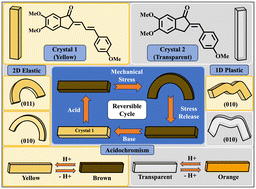
The development of stimuli-responsive smart molecular crystals that maintain their structural integrity under mechanical stress is essential for advancing smart, functional, and adaptable crystalline materials. To achieve a combination of mechanical flexibility and acidochromism in molecular crystals, we designed two benzylideneindanone derivative-based crystals, referred to as crystals 1 and 2. Crystal 1 exhibits 2D elasticity on the (011) and (010) faces, resulting from isotropic packing features within an anisotropic layered structure. In contrast, both crystals 1 and 2 demonstrate 1D plastic behavior on the (011) face, attributed to layer migration under applied stress within the short-range domain of the crystals. Additionally, both crystals 1 and 2 show reversible acidochromism in response to acid vapor. Unlike most acid-responsive crystals that become brittle when exposed to acid, our crystals retain their mechanical flexibility while undergoing color changes in the presence of acid vapor. This unique combination of mechanical resilience and chromic response expands the potential applications in dynamic molecular crystals, including chemical sensing, reversible security tagging, and mechanically adaptive devices.
 Please wait while we load your content...


