


Mapping anisotropic compression and interatomic interactions in diopside (CaMgSi2O6) through a Hirshfeld-volume-driven equation of state

Abstract
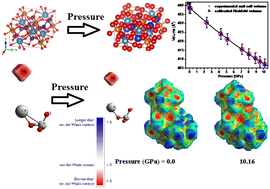
We introduce a Hirshfeld-volume-driven equation of state (EoS) to resolve atomistic compression mechanisms in diopside (CaMgSi2O6) under high pressure (0–10.16 GPa). Our approach integrates topological electron density partitioning via Hirshfeld surface analysis with third order Birch–Murnaghan EoS, achieving <2% error in Hirshfeld volume (VH) predictions versus experimental benchmarks. Critically, this method visualizes and quantifies how interatomic contacts and crystal packing evolve under compression. Hirshfeld analysis reveals a stark differential atomic compressibility: Mg atoms dominate strain absorption (ΔVatom/Vatom = −16.2% at 10.16 GPa), followed by Ca (−12.7%), Si (−8.54%), and O (−4.60%). This hierarchy arises from the flexible coordination environments of Mg/Ca–O polyhedra (bulk modulus B0 ≈ 85 GPa) accommodating compression via bond shortening, while the rigid SiO4 tetrahedra (B0 > 150 GPa) preserve the supramolecular architecture. Calibrated Hirshfeld volume-EoS parameters (VH = 438.72 Å3, B0 = 119.0 GPa,  = 3.44) align with experiments (ΔVH < 0.03%), providing a profound link between microscopic interactions and macroscopic properties. This work establishes the Hirshfeld-driven EoS as a transformative tool for decoding structure–property relationships in molecular crystals and designing pressure-resilient functional materials.
 Please wait while we load your content...


