


 PLATFORM UPDATE:


Modulating the coordination environment of electrochemical catalysis for enhanced catalytic performance
 *ac
and
Xiangwen
Liu
*b
*ac
and
Xiangwen
Liu
*b
Abstract
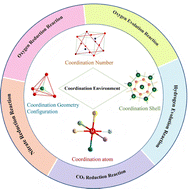
Electrochemical catalysis serves as the cornerstone for a sustainable future, enabling clean energy conversion and advancing green chemical synthesis. Understanding and designing catalysts help us develop more efficient catalysts. This paper systematically summarizes the regulatory mechanisms of the coordination environment in typical electrocatalytic reactions, covering oxygen reduction reactions (ORRs), oxygen evolution reactions (OERs), hydrogen evolution reactions (HERs), carbon dioxide reduction reactions (CO2RRs), and nitrogen reduction reactions (NRRs). It focuses on elucidating the concepts of different ligand types, coordination numbers, coordination configurations, and local geometries, as well as their varying effects on the electronic structure of active sites, the adsorption behavior of reaction intermediates, and the modulation of reaction pathways. This review first classifies and summarizes various strategies for regulating the coordination environment from the perspective of catalysts. Subsequently, starting from the mechanism of each reaction and focusing on the rate-determining steps, it summarizes the central role of the coordination environment in regulating key reaction intermediates, reducing energy barriers, and promoting multi-electron transfer processes. It also outlines common coordination-based regulation strategies and the preparation methods for different reaction types. Furthermore, this paper summarizes recent advances in enhancing catalytic activity, selectivity, and stability through coordination environment regulation strategies, while also discussing the challenges and future directions in this field. Ultimately, the aim is to provide an in-depth analysis of catalyst performance from the perspective of the coordination environment and to offer guidance for catalyst design.
- This article is part of the themed collection: ChemComm Electrocatalysis
 Please wait while we load your content...


