


 PLATFORM UPDATE:


Excited-state magneto-optical effects in organic semiconductors

Abstract
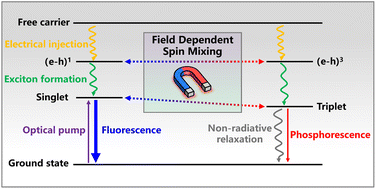
Magneto-optical effects in organic semiconductors, including magneto-photoluminescence (MPL) and magneto-electroluminescence (MEL), enable magnetic control of light emission at low fields and room temperature. This review focuses on the basic concept and recent advances of magneto-optical effects observed in organic semiconductors and devices. The underlying mechanisms for spin-dependent excited-state processes responsible for the MPL and MEL effects are briefly introduced. Singlet–triplet conversion is observed in a series of materials, including conjugated molecules, organic-metal complexes, exciplexes and acenes, to establish the structure–property relationship between molecular systems and MPL/MEL performance. Emerging applications based on MPL/MEL are summarized, such as magnetic field sensing, magnetically tuned light-emitting devices, and on-chip integrated magneto-optical devices. This is beneficial for the rational design and fabrication of spin-optoelectronic materials and devices and promotes the combination of organic spintronics and photonics beyond the traditional inorganic semiconductors.
- This article is part of the themed collection: New Developments in Photofunctional Materials and Transformations
 Please wait while we load your content...


