


 PLATFORM UPDATE:


Noble metal–TMO–carbon hybrid catalysts for solar-driven antibiotic detoxification in wastewater

Abstract
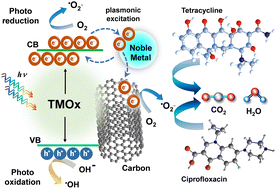
The increasing presence of antibiotic residues in aquatic environments has become a major environmental concern due to their persistence, ecological toxicity, and role in accelerating antimicrobial resistance. However, beyond the environmental challenge, the development of efficient catalytic systems capable of utilizing solar energy for complete mineralization remains a critical research priority. Conventional wastewater treatment processes often fail to completely remove these active pharmaceutical ingredients (APIs) and their complexes with dyes and other co-contaminants, which can accumulate in the aquatic ecosystems and accelerate the propagation of antibiotic resistance. This feature article provides a focused review of recent advances in noble metal–transition metal oxide (TMO)–carbon hybrid catalysts designed for the efficient antibiotic detoxification in wastewater. Particular emphasis is placed on the rationale for integrating noble metals and conductive carbon frameworks with TMOs to overcome intrinsic limitations and achieve enhanced light harvesting, efficient charge separation, and accelerated interfacial charge transfer. Key material architectures, including the plasmon-enhanced Ag–TiO2 systems, defect-engineered Ag–ZnO nanostructures, Z-scheme based heterojunctions, external-field-assisted catalytic systems based on piezo-, pyro-, and tribo-phototronic effects, and carbon-integrated TMO membranes, are discussed to illustrate how synergistic interactions among noble metals, semiconducting oxides, and conductive carbon frameworks enhance solar-light utilization and overall catalytic activity.
 Please wait while we load your content...


