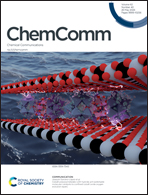
Synchronizing proton–electron transfer in nanoconfined Cu–Ni alloys enables highly selective nitrate-to-ammonia conversion

Abstract

The Cu–Ni alloy interface establishes cooperative adsorption–hydrogenation units that align intermediate binding with hydrogenation kinetics, thereby lowering the energy barriers for sequential deoxygenation steps, suppressing the competing hydrogen evolution reaction, delivering a faradaic efficiency of 96%.

Graphical abstract: Synchronizing proton–electron transfer in nanoconfined Cu–Ni alloys enables highly selective nitrate-to-ammonia conversion

Supplementary files

Article information

Article type
Communication
Submitted
18 Mar 2026
Accepted
18 May 2026
First published
19 May 2026

Chem. Commun., 2026, Advance Article

Synchronizing proton–electron transfer in nanoconfined Cu–Ni alloys enables highly selective nitrate-to-ammonia conversion

P. Yan, Z. Huang, Y. Zhang, L. Gu, S. Bai, Y. Hua, M. Kuang and J. Yang, Chem. Commun., 2026, Advance Article , DOI: 10.1039/D6CC01637E

To request permission to reproduce material from this article, please go to the Copyright Clearance Center request page.

If you are an author contributing to an RSC publication, you do not need to request permission provided correct acknowledgement is given.

If you are the author of this article, you do not need to request permission to reproduce figures and diagrams provided correct acknowledgement is given. If you want to reproduce the whole article in a third-party publication (excluding your thesis/dissertation for which permission is not required) please go to the Copyright Clearance Center request page.

Read more about how to correctly acknowledge RSC content.

Social activity

Spotlight

Advertisements