


 PLATFORM UPDATE:

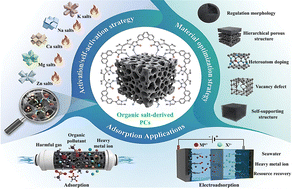
Activation/self-activation, construction, material optimization strategies and adsorption/electroadsorption applications of organic salt-derived porous carbons
 *bc
*bc
Abstract
Nowadays, with the accelerated advances in industrialization, substantial amounts of pollutants are being released into nature, inducing severe hazards to ecosystems and human health. While porous carbons (PCs) hold overt promise for environmental remediation, their synthesis is enormously constrained by high costs, severe equipment corrosion and evident environmental risks. This review provides an overview of the emerging organic salt-derived PCs (OAPCs), aiming to explore advanced green PCs. Initially, their multifunctional roles as activators and self-activators are underlined. Then, a multifold range of K-, Na-, Zn-, Mg- and Ca-based organic salts is systematically expounded, with a focus on their diverse decomposition routes and activation mechanisms. More importantly, multiple material optimization strategies, involving regulation morphology design, hierarchical porous structure establishment, heteroatom doping engineering, vacancy defect engineering and self-supporting structure design, have been successively explored, which aim to maximize surface accessibility, electronic conductivity and matter migration–diffusion–adsorption ability. Ultimately, the potential adsorption and electroadsorption applications of OAPCs are further estimated, aiming to realize effective organic pollutant removal, heavy metal ion capture, and seawater desalination and resource recovery. In summary, this review seeks to guide the design of high-performance green OAPCs and provide meaningful perspectives for their in-depth use as effective pollutant capture and resource recycling materials.
 Please wait while we load your content...


