Efficient seawater electrolysis for hydrogen production with a NiS2-stabilized 1T-MoS2 catalyst

Abstract

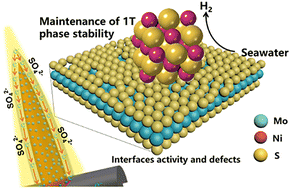
A simple method to introduce NiS2 into 1T phase MoS2 to strengthen the Mo–H bonds during the seawater electrolysis, which improves the structural stability of the MoS2 catalyst, is presented. 1TMoS2–NiS2/CC achieved an ultra-low overpotential and a Tafel slope of 45.9 mV dec−1. The seawater electrolysis device only needs 1.67 V to achieve 100 mA cm−2, and run continuously for 100 h.

Graphical abstract: Efficient seawater electrolysis for hydrogen production with a NiS2-stabilized 1T-MoS2 catalyst

Supplementary files

Transparent peer review

To support increased transparency, we offer authors the option to publish the peer review history alongside their article.

View this article’s peer review history

Article information

Article type
Communication
Submitted
06 Feb 2026
Accepted
27 Mar 2026
First published
30 Mar 2026

Chem. Commun., 2026, Advance Article

Efficient seawater electrolysis for hydrogen production with a NiS2-stabilized 1T-MoS2 catalyst

L. Wu, H. Wei, H. He, Y. Xiang, S. Yin, D. Guo, G. Fang, H. Jin, X. Chen and S. Wang, Chem. Commun., 2026, Advance Article , DOI: 10.1039/D6CC00810K

To request permission to reproduce material from this article, please go to the Copyright Clearance Center request page.

If you are an author contributing to an RSC publication, you do not need to request permission provided correct acknowledgement is given.

If you are the author of this article, you do not need to request permission to reproduce figures and diagrams provided correct acknowledgement is given. If you want to reproduce the whole article in a third-party publication (excluding your thesis/dissertation for which permission is not required) please go to the Copyright Clearance Center request page.

Read more about how to correctly acknowledge RSC content.

Social activity

Spotlight

Advertisements