d-State modulation in Cu2SnS4 governs electronic transport descriptors and VOC sensing selectivity: a DFT-BoltzTraP2 study

Sathish Panneer Selvam *a and Sungbo Cho *abc
aDepartment of Electronic Engineering, Gachon University, Seongnam-si, Gyeonggi-do 13120, Korea. E-mail: satp103@gachon.ac.kr, sbcho@gachon.ac.kr
bDepartment of Semiconductor Engineering, Gachon University, Seongnam-si, Gyeonggi-do 13120, Korea
cGachon Advanced Institute for Health Science & Technology, Gachon University, Incheon 21999, Korea

Received 19th January 2026 , Accepted 29th January 2026

First published on 30th January 2026


Abstract

d-State modulation in Cu2SnS4  provides a rational route for dopant-selective electronic tuning and VOC sensing.
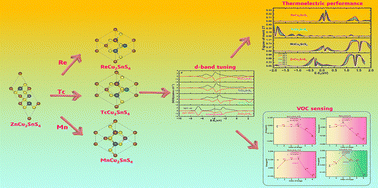

The substitution of Zn sites in Cu2ZnSnS4 (kesterite) with transition metals (Mn, Tc, Re) provides substantial adsorptive sites for VOC adsorption and electronic response through interconnected structural, defect, and interfacial influences. Density functional theory and defect-chemistry investigations reveal that the substitution of Mn in kesterite mitigates Cu–Zn antisite disorder, generates local magnetic moments, and reduces the band gap by positioning 3d states close to the Fermi level (EF).1,2 The observed effects enhance the electronic states, fortify the hybridization between molecules and surfaces, and facilitate charge-transfer-mediated chemisorption. These trends align with findings from other sensing platforms that incorporate van der Waals interactions and metal doping, where d-state effects are linked to adsorption energies, shifts in density of states, and the polarity of the response. Building upon this strategy, the introduction of Mn, Tc, and Re dopants in Cu2SnS4 creates localized d-states near EF and adjusts carrier density, thereby selectively improving the adsorption of π-conjugated and polar volatile organic compounds (VOCs). Similar selectivity adjustments in doped 2D chalcogenides (e.g., MoS2, WS2) have been associated with the activation of adsorptive sites and the passivation of edges.3,4 In this order, Mn highlights its superiority as the most scalable and well-supported option in the literature: it effectively couples spin-polarized channels to VOC binding, preserves the structural stability of sensor materials, and facilitates controlled chemisorption. Re generates more intense local electronic disruptions, yet it incurs greater expenses and increases synthetic complexity. Tc exhibits significant d-state modulation; however, its practicality is hindered by radioactivity. Consequently, the substitution of Mn provides a systematic and scalable approach for adjusting adsorption strength, DOS alignment, and spin-selective charge transfer within a kesterite framework. Meanwhile, DFT workflows effectively measure adsorption energies, DOS shifts, work-function variations, and desorption barriers for VOC pre-screening before fabrication.3,5,6

VOCs, including 1,3-butadiene (BTD), formaldehyde (FA), and trichloroethylene (TCE), are designated as Group 1 carcinogens by the International Agency for Research on Cancer (IARC) and are subject to regulation by the World Health Organization (WHO) (Table S1). Exposure limits are established at 2–3 µg m−3 for BTD (annual), 100 µg m−3 for FA (30 min), and approximately 2 µg m−3 for TCE (annual), based on their links to leukaemia, nasopharyngeal cancer, and kidney malignancies, respectively.7,8 The early and selective identification of carcinogenic volatile organic compounds (VOCs) is crucial for source control, regulatory oversight, and non-invasive diagnostic methods, as metabolic reprogramming associated with disease generates VOC biomarkers in breath and biofluids.

The pristine ZnCu2SnS4 (ZCTS) tetragonal phase (a = b = 5.464 Å, c = 10.904 Å), featuring a Zn–S bond length of 2.368 Å (Fig. 1a). Introduction of transition metals (Mn, Tc, Re) at the Zn site induces significant structural reconfiguration, whereby all doped systems relax into a monoclinic C lattice (γ = 134.999°), primarily due to ionic radii differences and induced local electronic distortions. The metal–S bond lengths are decreased from 2.375 Å (Mn–S) to 2.266 Å (Tc–S) and 2.256 Å (Re–S), reflecting increasing metal–S covalent character as one moves from 3d to 5d metals.9–11 Substitutional formation energies are markedly lower (1.65–4.45 eV) compared to interstitial configurations (3.22–5.59 eV) (Table S3). This distinct energy separation signifies that dopant atoms preferentially occupy lattice positions instead of interstitial spaces under equilibrium growth conditions.12 The electronic band structure of ZCTS shows a direct band gap of 0.431 eV at the (Gamma) point, which is in line with the reported literature13 (Fig. 1b). When Mn is added, the band gap shrinks significantly to 0.174 eV (Fig. 1c).


image file: d6cc00344c-f1.tif
Fig. 1 Evolution of structural, electronic, and bonding characteristics in pristine and transition-metal-doped Cu2SnS4. (a) Relaxed geometries of kesterite ZnCu2SnS4 and its monoclinic analogues substituted with Mn, Tc, and Re, illustrating variations in metal–S bonds. (b) and (c) Electronic band structures demonstrate bandgap narrowing from Zn to Mn doping, respectively and (d) and (e) a semi-metallic transition behavior of Tc and Re doping, respectively. (f) and (g) Spin-resolved density of states and d-band alignment with respect to the Fermi level, respectively. Shift in d-band centre as a function of dopant type.

This is because Mn 3d midgap states and spin exchange splitting are included, which is linked to a high-spin 3d5 structure. Tc (Fig. 1d) and Re (Fig. 1e) doping diminish the band gap (0 eV) with finite electronic states observed at the Fermi level, suggesting the semimetallic characteristics of Tc and Re-doped systems.14 The strong hybridization between d states of Tc/Re with S 3p orbitals leads to enhanced electronic screening and alters surface charge response during VOC adsorption. The spin-polarized DOS channels support this, since Zn and Re-based crystals have high-spin symmetry, while Tc doping established a minimal asymmetry. On the other hand, Mn-based system established an asymmetrical spin-polarized DOS due to the partially filled 3d5 orbitals15 (Fig. 1f).

Bader charge analysis (Fig. S1) further underlines the increase in covalency upon doping, with partial charge transfer from M to S decreasing progressively from Zn (0.892 e donated) to Re (0.916 e), alongside increased S electron density delocalization. These findings are supported by d-band center analysis, where Mn displays the lowest spin-down d-band (−1.204 eV), favoring enhanced surface reactivity, while Tc and Re show broader d-states closer to EF, consistent with their semimetallic behavior (Fig. 1g).15

The (112) surface has been extensively utilized as a representative and energetically favourable surface in theoretical investigations of kesterite-based chalcogenides.16 In addition, the (112) surface has a low-index, non-polar and stoichiometric termination that exposes both metal and S sites (Fig. S4). To probe VOC sensing characteristics, three carcinogenic VOCs, BTD, FA, and TCE, were relaxed on the relaxed (112) surfaces of ZCTS and its doped analogues (Fig. S5). Adsorption distances span 3.268–3.518 Å, indicating predominant physisorption for BTD, whereas FA and TCE exhibit moderate chemisorption, particularly on Mn- and Tc-substituted surfaces. The shortest interaction distance of 3.121 Å for FA on MnCu2SnS4 highlights the strong dipole–metal interaction mediated by the C[double bond, length as m-dash]O group. TCE shows the smallest distance on TcCu2SnS4 (2.308 Å), consistent with specific Cl–metal orbital interactions.17,18

Charge density difference (CDD) plots (Fig. 2a and Fig. S6) reveal minimal electron redistribution for BTD across all systems, in agreement with its low polarity and planar structure. By contrast, FA demonstrates localized charge accumulation at the oxygen center, particularly on Mn and Tc systems, indicating charge transfer-mediated stabilization via dipole-surface interactions. TCE adsorption induces extensive electron rearrangement exclusively on TcCu2SnS4, reflecting strong hybridization between Cl 3p and Tc 4d states. The analysis of adsorption energy (Eads) (Fig. 2b) offers valuable insights into the sensing characteristics. For BTD, all doped surfaces display weak adsorption energies (−0.232 to −0.334 eV), low charge transfer (|ΔQ| ≤ 0.070 e) (Tables S5–S8), and negligible dopant charge transfer contribution (|ΔQ dopant|<0.03 e). Significant variations in the atomic charges of carbon and hydrogen are observed upon adsorption in all doped systems, suggesting charge polarization of the BTD molecule (Table S5). This behavior shows delocalized charge redistribution and dispersion-dominated physisorption, which explains the poor binding and reversible contact across all dopants. Adsorption increases the electron density on the oxygen atom in comparison to the FA-only configuration, especially in systems doped with Mn and Tc (Table S6). FA adsorption is clearly dependent on the dopant species. MnCu2SnS4 has the strongest interaction (Eads = −0.49 eV), with significant charge transfer (ΔQ = −0.181 e) and a positive Mn Bader charge (+ 0.054 e). This demonstrates that charge transfer occurs from Mn 3d to O 2p, and dipole-driven adsorption. Tc- and Re-doped systems exhibit weaker FA adsorption (Eads ≈ −0.14 to −0.17 eV) and smaller ΔQ values (∼−0.08 to −0.09 e), indicating stronger electronic screening and less charge localization. The Bader charge analysis for TCE adsorption is summarized in Table S7. Upon adsorption, carbon atoms show partial electron depletion, indicating intramolecular charge rearrangement mediated by surface contact, whereas chlorine atoms show significant negative charge accumulation. TCE exhibited the strongest adsorption on TcCu2SnS4, with Eads = −1.152 eV and the highest charge transfer (ΔQ = −0.260 e). The positive Tc Bader charge (+0.151 e) suggests electron depletion at the Tc site, indicating directional Cl–Tc orbital hybridization rather than electrostatic contact. Mn- and Re-doped surfaces have significantly lower TCE binding (Eads = −0.37 to −0.39 eV; |ΔQ| < 0.13 e), indicating less efficient halogen-metal interaction.


image file: d6cc00344c-f2.tif
Fig. 2 VOC adsorption behavior on Mn- and Tc-doped Cu2SnS4 surfaces. (a) Charge density difference plots highlighting physisorption of BTD, dipole-driven adsorption of FA, and strong Cl–metal interaction for TCE on TcCu2SnS4 and (b) Adsorption energies confirming weakest interaction for BTD and strongest binding of TCE on TcCu2SnS4.

Climbing image (CI)-nudged elastic band (NEB) calculations further validate the adsorption and desorption via minimum energy path (MEP) (Fig. 3). MnCu2SnS4 exhibits ultralow barriers for BTD (0.009 eV) and FA (0.070 eV), indicating fast and reversible adsorption (Fig. S7). TCE adsorption on TcCu2SnS4 features a higher kinetic barrier (0.174 eV), consistent with strong adsorption and limited reversibility, which is ideal for persistent chlorinated VOC capture.


image file: d6cc00344c-f3.tif
Fig. 3 CI-NEB minimum energy pathways (MEP) for VOC adsorption on Mn- and Tc-doped Cu2SnS4 surfaces. Optimized states (initial state (IS) to transition state (TS) and TS to final state (FS) for (a) BTD, (b) FA and (c) TCE adsorption on MnCu2SnS4, and (d) TCE adsorption on TcCu2SnS4, showing adsorption geometries and transition states.

The dynamical and thermal stability of pristine and transition-metal-doped Cu2SnS4 was thoroughly assessed through the examination of phonon dispersion relations and vibrational thermodynamic characteristics. The computed phonon spectra of ZnCu2SnS4, MnCu2SnS4, TcCu2SnS4, and ReCu2SnS4 display no imaginary frequencies within the Brillouin zone, thereby affirming the dynamical stability of all doped configurations (Fig. S8).19 The minor softening of low-frequency acoustic modes in the doped systems arises from finite supercell and force-constant truncation effects and does not signify structural instability. The thermal stability was additionally evaluated using temperature-dependent vibrational Helmholtz free energy F(T), entropy S(T), and constant-volume heat capacity Cv(T), as illustrated in Fig. 4. All systems exhibit a smooth and monotonic progression of F(T) (Fig. 4a), S(T) (Fig. 4b), and Cv(T) (Fig. 4c) across the temperature spectrum of 0–1000 K, following to accurate low-temperature constraints (S = 0, Cv = 0 at T = 0 K) and high-temperature saturation characteristics.20,21 The absence of thermodynamic variances confirms the resilience of the lattice vibrations and underscores the thermal stability of the doped Cu2SnS4 frameworks. The results indicate that transition-metal substitution maintains lattice stability while facilitating significant electrical and adsorptive modification essential to VOC detection.


image file: d6cc00344c-f4.tif
Fig. 4 Temperature-dependent (a) vibrational Helmholtz free energy F(T), (b) entropy S(T), and (c) constant-volume heat capacity Cv(T) of ZnCu2SnS4, MnCu2SnS4, TcCu2SnS4, and ReCu2SnS4, obtained from phonon calculations at varrying temperature range from 0 to 1000 K.

In summary, transition-metal substitution in Cu2SnS4 modulates structural symmetry, electronic dispersion, and VOC surface reactivity. Mn substitution enhances sensing performance: MnCu2SnS4 exhibits a narrow band gap of 0.174 eV, retains semiconducting behavior, and shows enhanced carrier responsiveness. The Mn 3d states shift toward the Fermi level, altering the d-band center (−1.204 eV) and producing an asymmetric spin-polarized DOS, improving adsorbate-surface orbital overlap and charge-transfer susceptibility while avoiding metallic screening. Consequently, MnCu2SnS4 shows a robust electrostatic response to non-polar (BTD), polar (FA), and chlorinated (TCE) VOCs, enabling universal sensing. Tc substitution reduces the band gap to zero via strong Tc 4d–S 3p coupling, leading to selectivity for chlorinated VOCs such as TCE. Re substitution similarly approaches a semimetallic limit through Re 5d–S 3p hybridization; however, enhanced 5d delocalization increases electronic screening, resulting in weaker and less selective VOC interactions than Tc. These trends are supported by dielectric enhancement, d-band modulation, and EXAFS coordination analysis, while phonon dispersion and vibrational thermodynamics confirm stability. The correlation between d-band center tuning and adsorption behavior identifies MnCu2SnS4 for reversible detection and TcCu2SnS4 for persistent chlorinated-VOC capture.

This research was supported by the National Research Foundation of Korea (NRF-2023R1A2C1003669).

Conflicts of interest

There are no conflicts to declare.

Data availability

The data supporting this article have been included as part of the supplementary information (SI). Supplementary information: computational details, crystallographic information files and other DFT studies. See DOI: https://doi.org/10.1039/d6cc00344c.

References

  1. S. Chen, A. Walsh, X.-G. Gong and S.-H. Wei, Adv. Mater., 2013, 25, 1522–1539 CrossRef CAS PubMed .
  2. K. Ramasamy, M. A. Malik and P. O’Brien, Chem. Commun., 2012, 48, 5703–5714 RSC .
  3. T. Kim, T. H. Lee, S. Y. Park, T. H. Eom, I. Cho, Y. Kim, C. Kim, S. A. Lee, M.-J. Choi, J. M. Suh, I.-S. Hwang, D. Lee, I. Park and H. W. Jang, ACS Nano, 2023, 17, 4404–4413 CrossRef CAS PubMed .
  4. L.-Y. Zhu, L.-X. Ou, L.-W. Mao, X.-Y. Wu, Y.-P. Liu and H.-L. Lu, Nano-Micro Lett., 2023, 15, 89 CrossRef CAS PubMed .
  5. W. Liu, A. Tkatchenko and M. Scheffler, Acc. Chem. Res., 2014, 47, 3369–3377 CrossRef CAS PubMed .
  6. Y. Wang, J. Chen, X. Wei, A. J. Hernandez Maldonado and Z. Chen, Environ. Sci. Technol., 2017, 51, 11820–11828 CrossRef CAS PubMed .
  7. Y. Yan, L. Peng, N. Cheng, H. Bai and L. Mu, Environ. Sci. Pollut. Res., 2015, 22, 15132–15144 CrossRef CAS PubMed .
  8. W.-T. Tsai, Atmosphere, 2023, 14, 242 CrossRef CAS .
  9. J. Lu and M. J. Clarke, J. Chem. Soc., Dalton Trans., 1992, 1243–1248 RSC .
  10. M. A. Reynolds, I. A. Guzei and R. J. Angelici, J. Am. Chem. Soc., 2002, 124, 1689–1697 CrossRef CAS PubMed .
  11. Z. Yan, X. Wang, R. Fei, R. Zhu, J. Zhao and W. Wang, Chem. Eng. J., 2024, 491, 152153 CrossRef CAS .
  12. Y. Li, D. Bahamon, M. Sinnokrot and L. F. Vega, npj Comput. Mater., 2022, 8, 229 CrossRef CAS .
  13. L. Weston and C. Stampfl, Phys. Rev. Mater., 2018, 2, 85407 CrossRef CAS .
  14. A. Yoshimura, N. Koratkar and V. Meunier, Nano Express, 2020, 1, 10008 CrossRef CAS .
  15. N. V. Kozyrev, K. A. Baryshnikov, B. R. Namozov, I. I. Kozlov, M. E. Boiko, N. S. Averkiev and Y. G. Kusrayev, Phys. Rev. B, 2025, 111, 134432 CrossRef CAS .
  16. K. C. Nwambaekwe, M. Masikini, P. Mathumba, M. E. Ramoroka, S. Duoman, V. S. John-Denk and E. I. Iwuoha, Nanomaterials, 2021, 11(3), 794 CrossRef CAS PubMed .
  17. O. C. Ngana, A. D. Nwagu, O. M. Oyebanji, S. H. Mohammed and N. A. Abdulhussein, Sci. Rep., 2025, 15, 34691 CrossRef CAS PubMed .
  18. X.-Q. Lin, Z.-H. Han, X. Zhang, J.-X. Yang and Y.-G. Yao, Phys. Chem. Chem. Phys., 2025, 27(42), 22809–22819 RSC .
  19. A. J. Jackson and A. Walsh, J. Mater. Chem. A, 2014, 2, 7829–7836 RSC .
  20. K. Kundavu, S. Mondal and A. Bhattacharya, Mater. Adv., 2023, 4, 4238–4249 RSC .
  21. J. Yang, X. Wen, H. Xia, R. Sheng, Q. Ma, J. Kim, P. Tapping, T. Harada, T. W. Kee, F. Huang, Y.-B. Cheng, M. Green, A. Ho-Baillie, S. Huang, S. Shrestha, R. Patterson and G. Conibeer, Nat. Commun., 2017, 8, 14120 CrossRef CAS PubMed .

This journal is © The Royal Society of Chemistry 2026
Click here to see how this site uses Cookies. View our privacy policy here.