


A MOF-derived Co3O4/Ni–Co sulphide heterojunction for ultra-stable sulphur oxidation
 *a
Liang
Chen
*a
*a
Liang
Chen
*a
Abstract
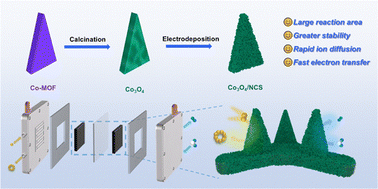
The thermodynamically favourable sulphur oxidation reaction (SOR) promises energy-efficient H2 production, but its practical deployment is severely hindered by rapid anode deactivation via sulphur passivation. Herein, we report a robust hierarchical heterostructure comprising Ni–Co sulphide nanosheets anchored on a ZIF-L-derived porous Co3O4 scaffold (Co3O4/NCS), which successfully surmounts this stability challenge. By establishing a strong structure–property correlation, we demonstrate that the conductive Co3O4 backbone not only provides mechanical stability but also dynamically modulates the electronic structure of the active sulphide phase to optimize intermediate adsorption. Consequently, the Co3O4/NCS electrode delivers exceptional SOR activity, achieving a current density of 100 mA cm−2 at a remarkably low potential of 0.303 V vs. RHE. Crucially, it demonstrates an extraordinary operational lifetime exceeding 300 hours, significantly outperforming state-of-the-art catalysts. This work provides a highly effective oxide/sulphide interfacial design strategy to prevent sulphur passivation for sustainable energy conversion.
 Please wait while we load your content...


