Promoting reactant accumulation at solid–liquid interfaces through microstrain–defect engineering in overall water splitting

Abstract

Herein, microstrain-engineered CoFePS derived from CoFeLDH enhanced the solid–liquid interface, improved ion diffusion and Cdl, and delivered 1.44 V at 10 mA cm² with over 200 h stability for efficient water electrolysis.
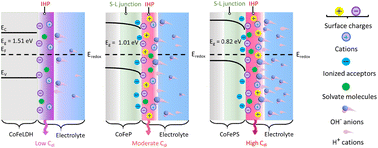
Graphical abstract: Promoting reactant accumulation at solid–liquid interfaces through microstrain–defect engineering in overall water splitting

Supplementary files

Transparent peer review

To support increased transparency, we offer authors the option to publish the peer review history alongside their article.

View this article’s peer review history

Article information

Article type
Communication
Submitted
06 Jan 2026
Accepted
01 Jun 2026
First published
02 Jun 2026

Chem. Commun., 2026, Advance Article

Promoting reactant accumulation at solid–liquid interfaces through microstrain–defect engineering in overall water splitting

Krishankant, A. Kumar, R. Bisht, R. Rani, G. P. Chauhan, P. Thakur, C. Bera and V. Bagchi, Chem. Commun., 2026, Advance Article , DOI: 10.1039/D5CC07320K

To request permission to reproduce material from this article, please go to the Copyright Clearance Center request page.

If you are an author contributing to an RSC publication, you do not need to request permission provided correct acknowledgement is given.

If you are the author of this article, you do not need to request permission to reproduce figures and diagrams provided correct acknowledgement is given. If you want to reproduce the whole article in a third-party publication (excluding your thesis/dissertation for which permission is not required) please go to the Copyright Clearance Center request page.

Read more about how to correctly acknowledge RSC content.

Social activity

Spotlight

Advertisements